
Addressing Climate Change Through Building Strategy
Climate change is no longer an abstract concept. Real, drastic effects now impact the globe, including North America. According to the American Society of Heating, Refrigerating and Air-Conditioning Engineers (ASHRAE) Handbook of Fundamentals: “We are now experiencing major changes in climate, both locally and globally, at rates 10 times greater than seen since the end of the last ice age 20,000 years ago—over decades instead of centuries or millennia.”
Historical data illustrates this shift:
-
Texas experienced energy shortages in 2021 that resulted in approximately one hundred deaths from extreme cold.
-
The Northwest heatwave in 2021 caused hundreds of fatalities, primarily within buildings lacking cooling infrastructure.
-
Hurricane Maria struck Puerto Rico in 2017 and triggered the world’s second-largest blackout.
-
The Northern California wildfire seasons from 2017-2019 stand as the most devastating on record and forced the nation’s largest investor-owned utility into bankruptcy.
-
Superstorm Sandy served as a critical wake-up call for the New York/New Jersey region when it hit with devastating force in 2012.
Countering climate change requires a fundamental focus on improving the environmental performance of homes and buildings. Building decarbonization and resiliency provide the technical framework for these improvements, ultimately leading to a superior human condition for all occupants.
The Built Environment’s Climate Impact
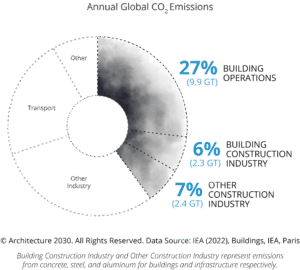
Buildings generate significant carbon (C02) emissions that directly impact the global climate. Recent data from Architecture 2030 highlights the industry’s footprint:
-
Global Emission Share: The built environment accounts for approximately 42% of annual global C02 emissions.
-
Operational vs. Embodied Carbon: Building operations—including heating, cooling, and lighting—contribute 27% of these emissions annually. Building materials and construction (embodied carbon) account for the remaining 15%.
-
Future Growth Projections: Estimates show the global building floor area doubling by 2060. This expansion equates to adding an entire New York City to the world every month for the next 40 years.
The Strategic Solution: Building Decarbonization
Reducing carbon emissions remains the primary method for mitigating climate change impacts. Effective decarbonization requires a thorough understanding of the processes and lifecycle stages involved. ASHRAE defines and categorizes the situation as follows:
-
Comprehensive Lifecycle Scope: Building decarbonization encompasses the entire lifecycle, including design, construction, operation, occupancy, and end-of-life phases.
-
Primary Emission Sources: Building construction, energy consumption, methane, and refrigerants serve as the leading sources of greenhouse gas (GHG) emissions.
-
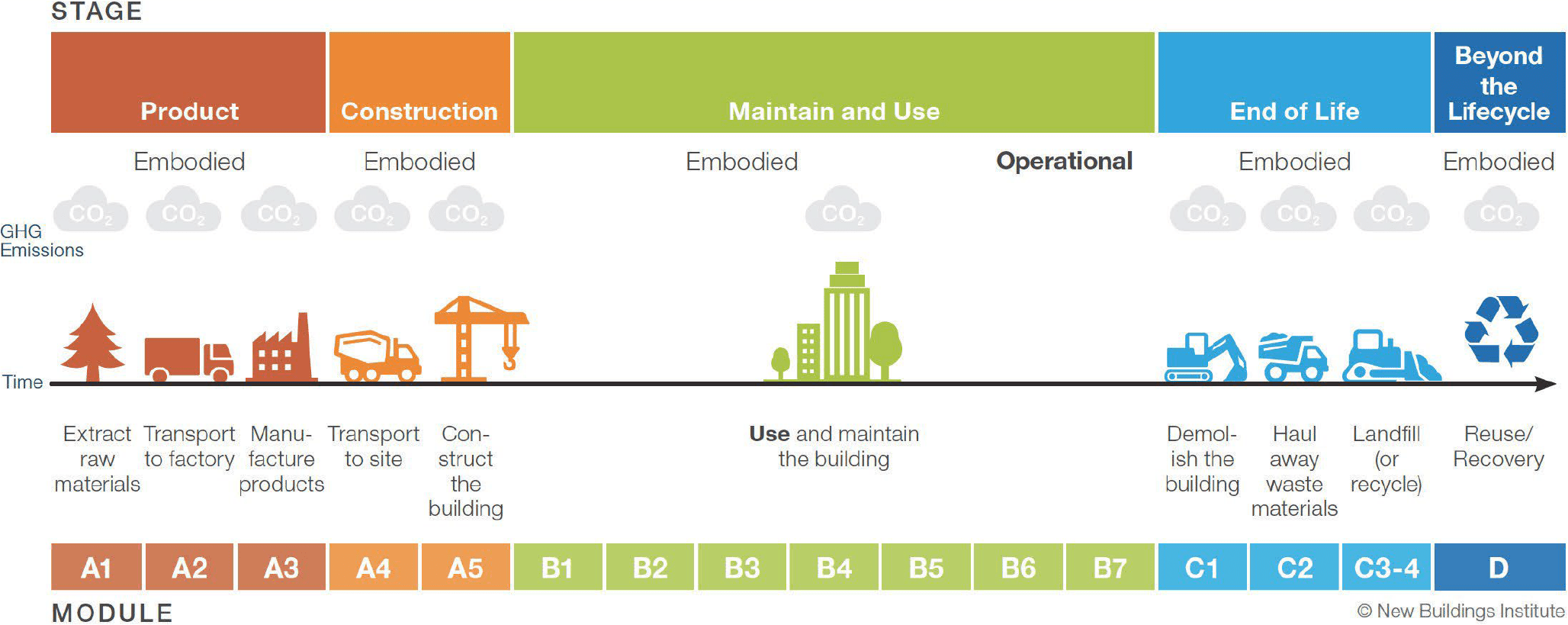
Operational vs. Embodied Emissions: A complete lifecycle assessment considers both operational emissions (primarily from energy use) and embodied emissions. Embodied carbon includes GHG emissions from the extraction, manufacturing, transport, and installation of materials, along with maintenance and end-of-life activities. It also accounts for refrigerant releases throughout the building’s existence.
The Solution? Building Decarbonization
Now we know why buildings must reduce carbon emissions to help counter climate change. Thus, if a building is to be decarbonized, we must first understand what building decarbonization is and what’s involved with the process. In that vein, ASHRAE analyzed the situation and determined the following:
Reducing carbon emissions remains the primary method for mitigating climate change impacts. To standardize industry efforts, ASHRAE defined the technical framework for building decarbonization in its 2022 Position Document. This framework, along with current ASHRAE decarbonization resources, categorizes the process through the following lifecycle lens:
-
Comprehensive Lifecycle Scope: Building decarbonization encompasses a structure’s entire lifecycle. This includes design, construction, operation, occupancy, and end-of-life phases.
-
Primary Emission Sources: Technical analysis identifies building construction, energy consumption, methane, and refrigerants as the leading sources of greenhouse gas (GHG) emissions.
-
Lifecycle Assessment (LCA): A complete LCA considers both operational emissions (primarily from energy use) and embodied emissions. Embodied carbon includes GHG emissions from the extraction, manufacturing, transport, and installation of materials, along with maintenance and end-of-life activities. It also accounts for refrigerant releases throughout the building’s existence
As such, ASHRAE supports the following goal of the Building To COP Coalition: “By 2030, the built environment should halve its emissions, whereby 100% of new buildings must be net-zero carbon in operation, with widespread energy efficiency retrofit of existing assets well underway, and embodied carbon must be reduced by at least 40%, with leading projects achieving at least 50% reductions in embodied carbon. By 2050, at the latest, all new and existing assets must be net zero across the whole lifecycle, including operational and embodied emissions.”
Global Goals for the Built Environment
Achieving international climate targets requires halving greenhouse gas emissions from the global built environment by 2030, using a 2015 baseline. To meet these objectives, building and building system evaluations must account for “Whole Life” GHG emissions rather than focusing solely on operational carbon. ASHRAE outlines the following mandates to reach these milestones:
-
2030 Operational Target: All new buildings must achieve net-zero GHG emissions during operation.
-
Retrofit Acceleration: Widespread energy-efficiency retrofits of existing assets must be well underway.
-
Embodied Carbon Reduction: New construction must reduce embodied carbon by at least 40%.
-
2050 Lifecycle Objective: All new and existing assets must reach net-zero GHG emissions across the entire life cycle by 2050.
Implementation Strategies for Building Decarbonization
Decarbonizing the built environment requires a multi-faceted technical approach aligned with the 2024 ASHRAE Position Document on Building Decarbonization. These strategies focus on minimizing Whole-Life Carbon (WLC) through lifecycle-specific actions.
Universal Strategies for All Building Types
Broadly applicable technologies and methodologies reduce emissions across the entire built environment:
-
Electrification and Heat Pumps: Modern heat pump technology and decarbonization tools fit a wide range of commercial applications.
-
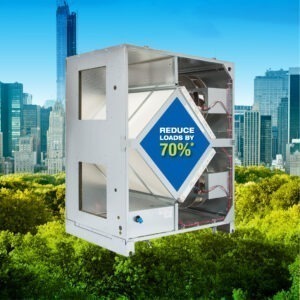
Energy Recovery Ventilation (ERV): ERVs serve as a primary decarbonization tool by capturing otherwise-wasted total energy (heat and humidity) from the exhaust airstream. This process pre-conditions incoming outdoor air, significantly reducing the heating and cooling loads on primary HVAC equipment. The EPA’s Energy Savings Plus Health Guide emphasizes that integrating energy efficiency and IAQ protection is essential, noting that energy recovery systems allow buildings to maintain high outdoor air ventilation rates while significantly reducing the load on HVAC equipment.
-
District-Scale Geothermal: Efficiently designed geothermal systems can service entire districts rather than single structures.
-
Thermal Energy Recovery: Capturing heat from wastewater, data centers, and industrial processes provides a viable heat source for neighboring buildings.
-
Whole-Building Life-Cycle Assessment (WBLCA): Utilizing WBLCA allows engineers to minimize environmental impacts by assessing both embodied and operational GHG emissions throughout the life of the building.
-
Optimized Operations and Maintenance (O&M): Best practices in O&M can reduce energy use by 10% or more. Effective O&M starts with energy sub-metering, monitoring systems, and structured commissioning. Replacing inefficient equipment prevents higher operational emissions.
Strategies for New Construction
New buildings provide the opportunity to integrate high-performance standards from the design phase. These strategies align with the ASHRAE 2025–2028 Strategic Plan, which prioritizes global leadership in the built environment’s transition to a sustainable future.
-
Design-Phase Goal Setting: Establishing decarbonization and Whole-Life Carbon (WLC) targets during the design phase maximizes long-term efficiency.
-
Passive Design and High-Efficiency Systems: Prioritizing passive design minimizes initial energy demand. Systems must align with ANSI/ASHRAE/IES Standard 90.1, which sets the global benchmark for energy-efficient building design.
-
Load Shifting and Grid Alignment: Integrating renewable energy and storage allows buildings to shift loads to align with lower-carbon periods on the grid. The DOE’s Building Technologies Office offers comprehensive resources on Grid-Interactive Efficient Buildings (GEBs) and load-shifting strategies.
-
Building Codes and Standards: Regulatory codes serve as the primary instruments for fostering widespread adoption of decarbonization practices. The International Code Council (ICC) provides technical resources on how modern codes support these initiatives.
Strategies for Building Retrofits
Existing buildings present complex challenges, but strategic design choices yield significant long-term payoffs:
-
Lifecycle Event Integration: Retrofitting is most effective during major lifecycle events, such as ownership changes, licensure renewals, or end-of-life equipment replacement.
-
Building Performance Standards (BPS): Mandatory BPS and appliance emission standards utilize these triggers to enforce significant emissions reductions in the existing building stock.
-
ANSI/ASHRAE/IES Standard 100: This standard provides the technical framework for setting energy performance targets and assessing efficiency levels in existing buildings. Detailed implementation data is available in the ASHRAE Standard 100-2024 Fact Sheet.
Building Decarbonization, Ventilation, and Indoor Air Quality
Effective building decarbonization requires technologies that maximize energy efficiency without compromising indoor air quality (IAQ). In the modern regulatory landscape, clean indoor air remains a critical requirement for occupant health and safety. Innovative ventilation systems, such as energy recovery ventilators (ERVs), resolve the tension between high-performance efficiency and indoor air quality requirements.
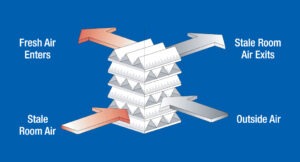
The Role of Balanced Ventilation
Increased and balanced ventilation serves as the most effective method for enhancing indoor air quality. Maintaining a controlled flow of filtered outdoor air while exhausting stale indoor air ensures high-quality interior environments. The American Lung Association confirms that proper ventilation is essential for maintaining healthy indoor conditions.
Mitigating Airborne Risks
A layered mitigation strategy, centered on increased ventilation, remains the industry standard for reducing the spread of airborne contaminants. The Centers for Disease Control and Prevention (CDC) emphasizes that improving ventilation in buildings protects people from germs that travel through the air. Furthermore, ASHRAE Standard 241 provides the formal technical framework for controlling infectious aerosols through enhanced ventilation and filtration.
Standardizing Higher Ventilation Rates
The global shift toward higher ventilation rates has transformed the “new normal” for building design. By increasing the volume of outdoor air, building systems continuously dilute indoor contaminants. ASHRAE guidance indicates that building operators should maximize outdoor air ventilation—to the extent that system and space conditions allow—to reduce the recirculation of indoor air.
The ERV Solution: Efficiency Meets Health
Conventional ventilation methods often waste energy, creating a conflict between indoor air quality goals and decarbonization efforts. Energy recovery ventilators resolve this conflict by capturing otherwise-wasted total energy—both heat and humidity—from the exhaust airstream to pre-condition incoming outdoor air.
Technical documentation from the EPA’s indoor air quality Design Tools highlights the efficiency of this process. Specifically, energy recovery equipment allows the energy implications of 15 cfm per person of outdoor air to behave like 5 cfm, while retaining the indoor air quality advantages of the higher 15 cfm rate. This leads to substantial reductions in both operational energy consumption and equipment costs.
Building Resiliency Supports Decarbonization
Climate change introduces significant challenges to the built environment, including extreme heat, increased precipitation, and rising sea levels. Furthermore, global health events have emphasized the role buildings play in safeguarding occupant health. It is imperative that buildings integrate building resiliency into their design and operation to ensure the success of long-term decarbonization efforts.
Defining Building Resiliency
The National Academy of Sciences defines resiliency as “the ability to prepare and plan for, absorb, recover from, and more successfully adapt to adverse events.” This definition, established in the landmark report Disaster Resilience: A National Imperative, serves as the foundational framework for modern infrastructure planning.
Expanding the Resiliency Framework
ASHRAE expands upon this foundational definition to include financial, political, and environmental threats, as well as disaster-, conflict-, or climate-related events. This perspective is formalized in the 2024 ASHRAE/CIBSE Joint Position Documentt, which asserts that building resiliency and decarbonization are interdependent, integrated objectives. Under this framework, achieving a net-zero carbon built environment is a prerequisite for long-term climate resiliency. Conversely, a building is not truly resilient if its operation accelerates the climate conditions that threaten its longevity.
Implementing Efficient Active Measures
To balance these dual requirements, ASHRAE and CIBSE advocate for a risk-based approach that combines passive design with high-efficiency active systems. Technical solutions must prioritize resource efficiency to ensure buildings remain habitable during extreme events or grid instability.
-
Load Mitigation: ERVs serve as a critical active measure by reducing the thermal energy required to condition outdoor air. This efficiency enables buildings to maintain indoor air quality standards even when operating under the energy constraints typical of post-disaster or high-demand scenarios.
-
Whole-Life Carbon (wlc) Considerations: Resiliency strategies must also account for whole-life carbon. Selecting durable, high-efficiency equipment like energy recovery ventilators reduces the need for frequent replacements and minimizes the embodied carbon impact of building maintenance over time.
Optimizing Clean Energy Consumption
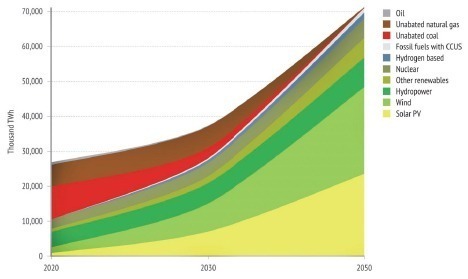
The success of building decarbonization depends heavily on the carbon intensity of the electric grid. When grid energy relies on fossil fuels, decarbonization efforts can be hindered. Consequently, clean grid energy remains a critical requirement for establishing a net-zero environment.
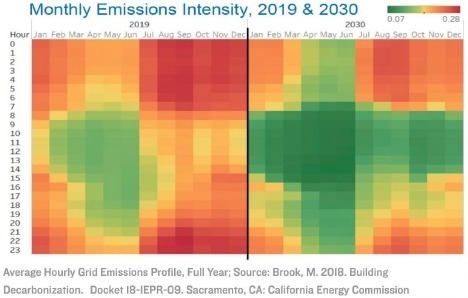
The cleanliness of this energy fluctuates based on the time of day and the season. For example, in regions like California, the electric grid is significantly cleaner during the morning hours of the first half of the year, while remaining carbon-heavy during late nights or early autumn mornings.
Building resiliency supports these efforts by ensuring structures remain functional and “online” during adverse climate conditions. When buildings maintain operational continuity, the grid can produce and distribute energy during these optimal “clean” windows. In this capacity, building resiliency serves as the foundation upon which effective building decarbonization is established.
How to Achieve Building Resiliency
To achieve building resiliency, the ASHRAE Position Document recommends several core strategies for engineering and design. These guidelines ensure that structures remain functional during and after environmental or social disruptions:
-
Extended System Design: Design and operate HVAC and other building systems to extend beyond standard energy efficiency and occupant health goals. Design must prioritize resistance to extreme events and ensure continued operation or reduced recovery time following catastrophic disruptions.
-
Envelope Integrity: Develop and maintain building envelopes that support resistance to and recovery from extreme weather and environmental stressors.
-
Site-specific considerations: Evaluate building sites and the placement of HVAC equipment within a structure to minimize physical risks that could compromise performance during a disaster.
Resiliency strategies for climate threats
While originally developed by the NYC Mayor’s Office to address local challenges, several strategies for building resiliency serve as a model for broader geographic application. These methods focus on three primary threats identified in modern climate projections: increasing heat, higher precipitation, and rising sea levels.
Strategies for Managing Increasing Heat
The urban heat island effect significantly impacts building energy loads. According to the NYC Climate Resiliency Design Guidelines, practitioners should prioritize thermal safety and system efficiency through the following measures:
-
Mitigate Urban Heat Islands: Ensure a minimum of 50% of the project’s site area is shaded, vegetated, or finished with high solar reflectance surfaces.
-
Reduce Industrial Heat Pollution: Utilize waste heat recovery technology and hvac controls for intermittent ventilation to minimize thermal discharge.
-
Implement Heat-Resilient Design: Use forward-looking climate data from the NYC Mayor’s Office of Climate & Environmental Justice rather than historical averages to select materials and identify potential points of failure.
-
Prioritize Thermal Safety: Incorporate mechanical cooling or resilient alternative cooling systems in occupied spaces to protect health during extreme heat events.
Strategies for Higher Precipitation
As precipitation intensity increases, managing on-site water and protecting internal systems are components to building resiliency. The AdaptNYC initiative highlights several adaptive measures:
-
Stormwater Management: Utilize green infrastructure, such as bioswales and detention tanks, to manage runoff and reduce the burden on municipal systems.
-
Floodproofing Mechanicals: Elevate critical hvac&r equipment above the projected design flood elevation (DFE) to ensure functional continuity during extreme rain events.
-
Moisture-Resilient Materials: Select building materials that resist mold growth and structural damage when exposed to increased humidity and moisture infiltration.
Strategies for Rising Sea Levels
For buildings in coastal or low-lying areas, resiliency requires protecting the building envelope and internal assets from surge and inundation:
-
Dry Floodproofing: Apply waterproof membranes and install flood shields at all openings to prevent water from entering the structure.
-
Wet Floodproofing: Design specific ground-level areas to allow water to move through without causing structural damage, while protecting all critical utilities.
-
Asset Relocation: Move electrical switchgear, fuel pumps, and energy recovery ventilators to upper floors or protected enclosures to prevent saltwater damage and ensure a faster recovery time.
Municipal Resiliency Plans Throughout the US
The strategies outlined by New York City represent just one example of the comprehensive approaches being developed across the United States to counter climate change. These frameworks increasingly incorporate specific mandates for the built environment to ensure long-term building resiliency and decarbonization.
Other major metropolitan areas have established similar roadmaps:
-
Boston: The Climate Ready Boston initiative focuses on protecting the city from sea-level rise and extreme heat through resilient infrastructure and neighborhood-scale coastal defense.
-
Atlanta: The city’s Climate Action Plan emphasizes equitable climate resiliency, focusing on energy efficiency and clean energy access to mitigate the urban heat island effect.
-
Miami: Through the MiamiForeverClimateReady strategy, the city prioritizes flood protection and adaptation measures to address the dual threats of sea-level rise and storm surges.
-
Los Angeles: L.A.’s Green New Deal, an update to the city’s Sustainable City pLAn, sets aggressive targets for zero-emission buildings and renewable energy integration to drive regional decarbonization.
By aligning building design with these regional climate action strategies, engineers and developers ensure that new and existing structures contribute to a broader, more resilient urban landscape.
Building Resiliency, Ventilation and Indoor Air Quality
Buildings that are resilient to climate change also support better IAQ. This is the case because as adverse conditions caused by climate change increase, a building that can withstand those events will be able to better safeguard occupant health and wellbeing. This includes maintaining clean and healthy indoor air for occupants to breathe via increased and balanced ventilation.
“…because most structures were built to withstand environmental conditions of their time. Thus, new structures must anticipate future climatic conditions in their design to avoid structural and environmental challenges.”
The EPA agrees with this notion in a report entitled, “Adapting Buildings for Indoor Air Quality in a Changing Climate.” It states that homes and buildings protect us from the outdoors, but face threats to IAQ due to climate change. That’s because most structures were built to withstand environmental conditions of their time. Thus, new structures must anticipate future climatic conditions in their design to avoid structural and environmental challenges. In a nutshell, resilient structures will be better able to protect IAQ.
Furthermore, the EPA stresses in the same report the significance of utilizing ventilation in resilient structural design. It states that ventilation is an important part of a building’s heating and cooling system because it helps reduce indoor pollutants. Weatherizing—which makes structures more resilient to the elements—without maintaining proper ventilation can negatively affect indoor air.
Government Action for Building Decarbonization and Resiliency
One of the fastest ways to achieve building decarbonization and resiliency is if governments step in with relevant legislation. Are governments up to the challenge? The United States Federal Government took a huge step in that direction recently with the Inflation Reduction Act. Also, in other regions across the U.S., legislators heeded the call and implemented their own laws. Here’s an overview of these efforts:
- Inflation Reduction Act: This new law provides $9 billion for states to issue rebates to homeowners for whole-home retrofits and for efficient heat pumps, heat-pump water heaters, other electrical equipment and training and education for contractors. It also restores and greatly increases tax credits for heat pumps and smaller home improvements, such as insulation, and strengthens the criteria for and the amount of the tax deduction for commercial building retrofits. Tax incentives for building highly efficient new homes and commercial buildings also get a big boost, including extra incentives for “zero-energy-ready” homes and buildings. The law also gives $1 billion in additional aid to help states and cities adopt and implement strong building energy codes.
- New York City’s Local Law 97: This law will limit GHG emissions for most buildings larger than 25,000 square feet. This process of rule-making involves finalizing a number of definitions of how carbon emissions are calculated and what are appropriate exceptions and allowances for buildings that have specific requirements and limitations related to their function.
- California’s 2022 Zero Code: This is a Zero Carbon Building (ZCB) energy standard for new nonresidential, high-rise residential and hotel/motel buildings, which are the prevalent building types being constructed in cities today.
- Maryland’s 2022 Climate Solutions Now Act: This law creates a building energy performance standard that requires most buildings over 35,000 square feet to start reporting their direct emissions from heating, starting in 2025. Those buildings will then be required to reduce those emissions by 20% below 2025 levels by 2030 and to achieve net-zero carbon emissions by 2040.
- Vermont’s 2021 Climate Action Plan: This law is a blueprint for future climate action. It lists two major suggestions for cutting GHG emissions from buildings. The first is to dramatically scale up the pace with which the state is weatherizing homes, and the second is heating buildings without fossil fuels through a clean heat standard.
Building Decarbonization + Resiliency = Improved Human Condition
When buildings are decarbonized and made more resilient, an underlying focus is not just maintaining sufficient IAQ, but actually improving it. That’s where energy-efficient ventilation technologies, such as ERVs, come into play as mentioned above. Thus, decarbonization and resiliency can directly improve not just IAQ, but also a building’s entire indoor environmental quality (IEQ).
Moreover, when a decarbonized and resilient building also enhances IAQ and IEQ, this leads to an improved human condition. Why is this the case? Because four of the principal elements to an improved human condition—health, wellbeing, cognitive function and productivity—are supported by building decarbonization and resiliency. Here’s how:
- Better health: Building decarbonization and resiliency are opportunities to also enhance IAQ and IEQ. When this is the case, occupants will be able to breathe in cleaner and healthier indoor air, which improves health.
- Bolstered Wellbeing: Decarbonized and resilient building helps to keep occupants safe from external risks. This fosters greater peace of mind, which leads to bolstered wellbeing.
- Greater Cognitive Function: When a decarbonized and resilient building also enhances IAQ, this can increase cognitive function. A Harvard study found that, on average, when compared to an indoor environment with deficient IAQ, cognitive scores were 61% higher in a simulated green-building environment with a low volatile organic compounds (VOCs) concentration. It also found that scores were 101% higher in a simulated green-building environment coupled with doubling the outdoor-air ventilation rate from 20 CFM per person (the rate recommended by ASHRAE) to 40 CFM per person.
- Increased productivity: If occupants are experiencing cognitive improvement due to enhanced IAQ in a decarbonized and resilient building, they could also be more productive. Another Harvard study found that doubling the rate of a conventional ventilation system from 20 CFM per person 40 CFM per person only costs about $32 per person, per year and leads to a productivity increase of $6,500 per person, per year. And if an ERV is added, the anticipated increase in energy costs can be reduced by up to 60%.
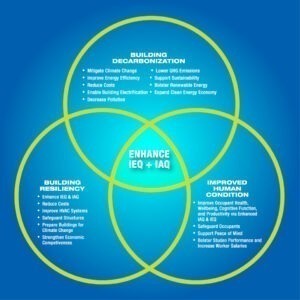
Venn Diagram: Building Decarbonization, Building Resiliency and Improved Human Condition
Now we see that to counter climate change, buildings must be decarbonized and made more resilient. In the process, the human condition can be improved. In essence, these are the three pillars of better buildings: decarbonization, resiliency and improved human condition. To demonstrate how they’re interconnected, I’ve compiled the below Venn diagram that shows at the core is enhanced IAQ and IEQ.
In Summary
Climate change is growing in severity, and action must be taken so it can be curbed. The built environment can play a central role in countering climate change via building decarbonization and resiliency. Such actions can help to support sustainability, while also improving the human condition. It’s a win-win for the environment and building occupant health and wellbeing.
To learn more about how energy recovery ventilation can enhance IAQ energy-efficiently, cost-effectively and sustainably, click here.