
How ERVs Work
As buildings get tighter to seal weather out, they seal in contaminants, causing deficient indoor air quality (IAQ). The best solution is increased and balanced ventilation with energy recovery ventilators (ERVs), which provide enhanced IAQ, greater ventilation efficiency and major energy cost savings.
Basic Principles of ERV Technology
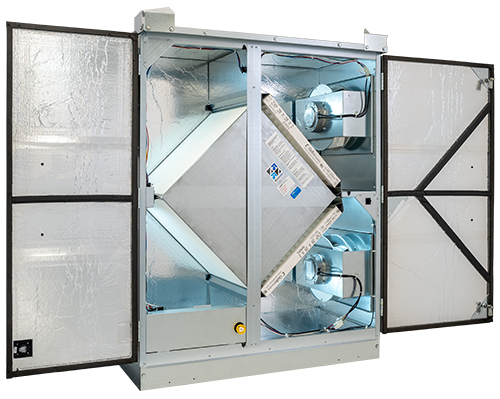
An energy recovery ventilator, or ERV, is a system that employs energy recovery technology, such as a static-plate core or rotating wheel. This process uses balanced airflows and recovers otherwise-expended total energy comprised of heat (sensible energy) and humidity (latent energy).
In summer, warm and humid outside air is pre-cooled and dehumidified via the total energy from the outgoing cool interior air. In winter, cold and dry outside air is preheated and humidified via the total energy from the outgoing warm interior air. Subsequently, less energy is needed for conditioning and ventilation, which means HVAC equipment can be downsized.
ERV Types
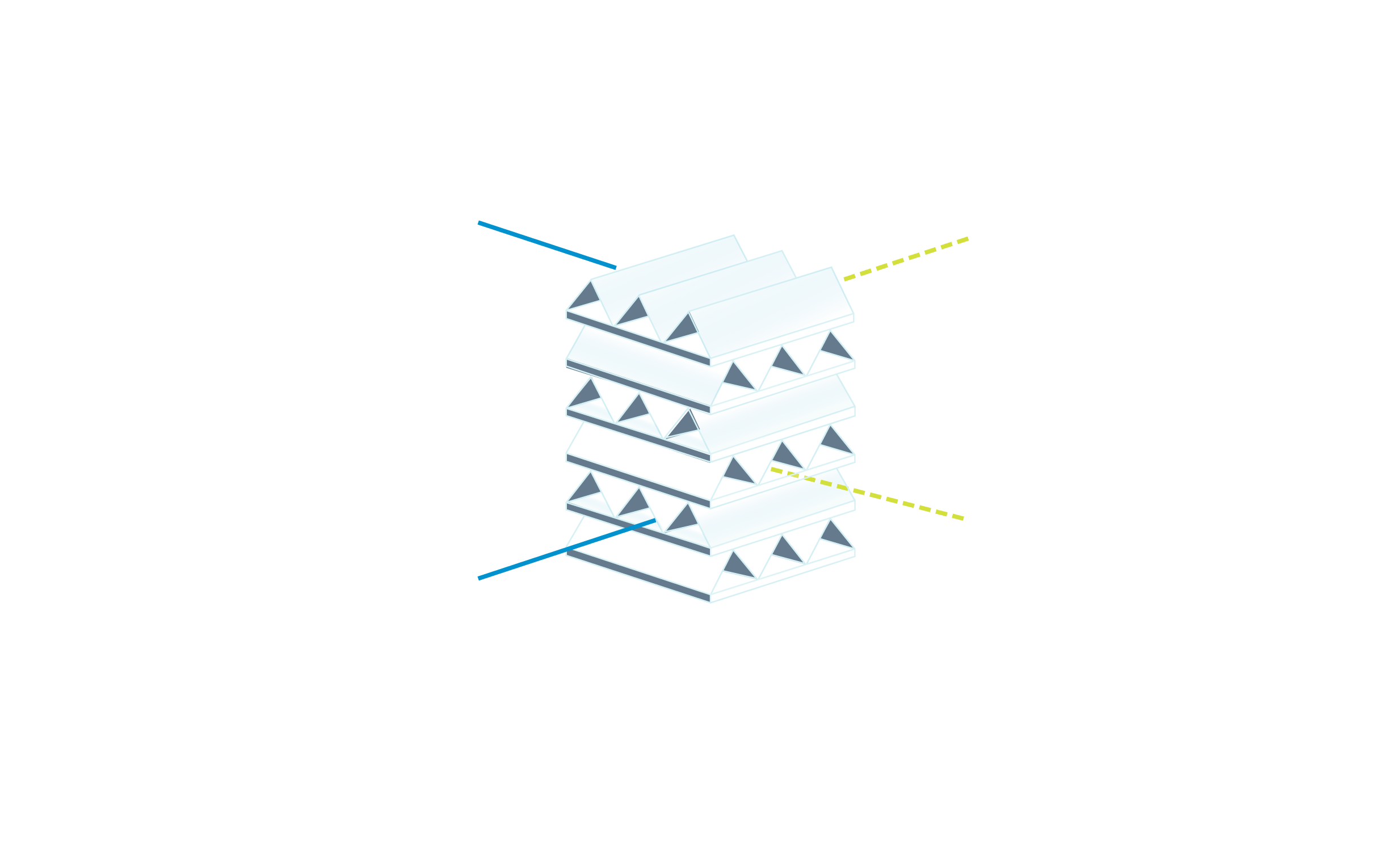
Not all ERVs are created equal. RenewAire’s high-efficiency, static-plate, enthalpy-core ERVs utilize a highly developed air-to-air energy-exchange core. Many layers of plates physically separate the airstreams so there’s no cross-contamination of the fresh air. The plates are made of an engineered “resin” material that simultaneously transfers heat through conduction and humidity by attracting bound water vapor from one airstream to the other. This is done while moderating extremes in both temperature and humidity.
The other ERV option uses a rotating wheel to transfer energy, and this can be problematic. First, wheel ERVs can suffer from leakage, which can create cross contamination in the air. Wheel-based ERVs are also more complex with more moving parts, which makes them more prone to breakdowns. Furthermore, the desiccant material used by wheel ERVs can wear away over time, thus requiring more maintenance. Finally, wheels require parasitic power for motorized rotation, which constantly consumes energy and impairs efficiency.
The Energy Recovery Process
Our ERVs moderate the extremes of outdoor supply-air temperature and humidity year-round, providing a sustainable ventilation solution for every climate.
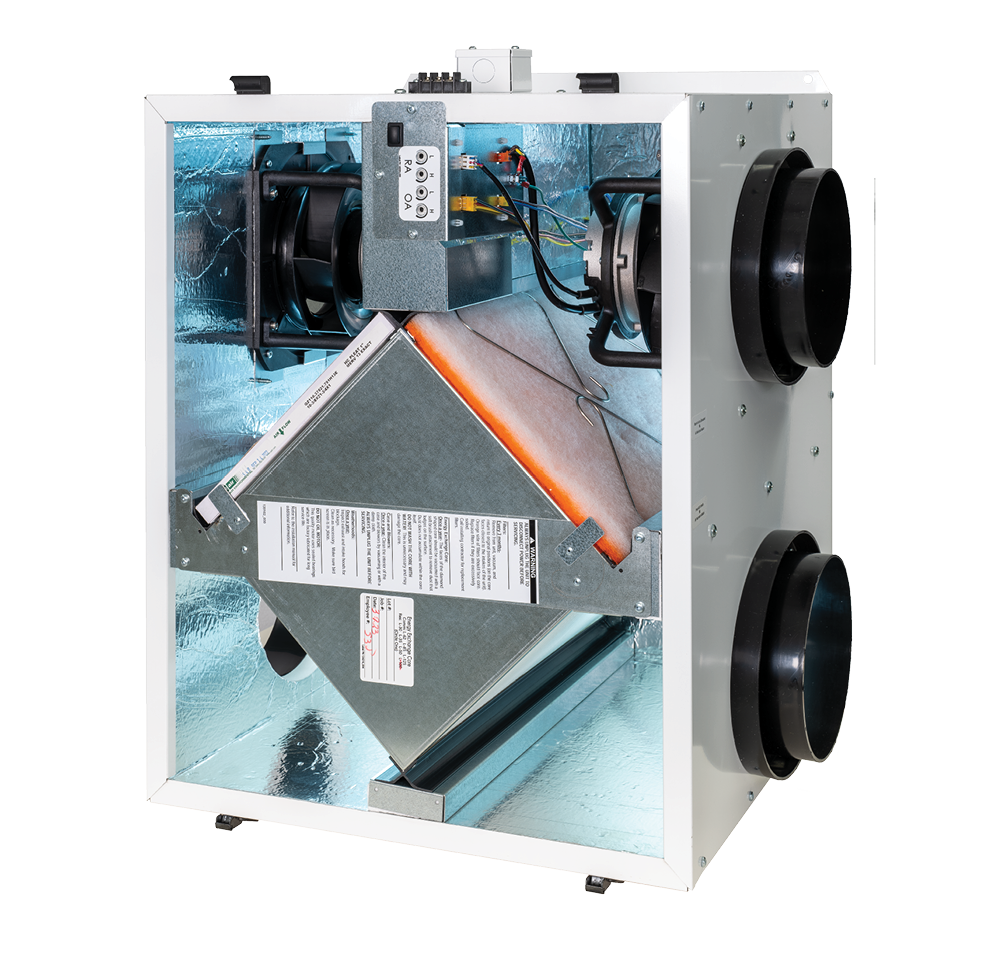
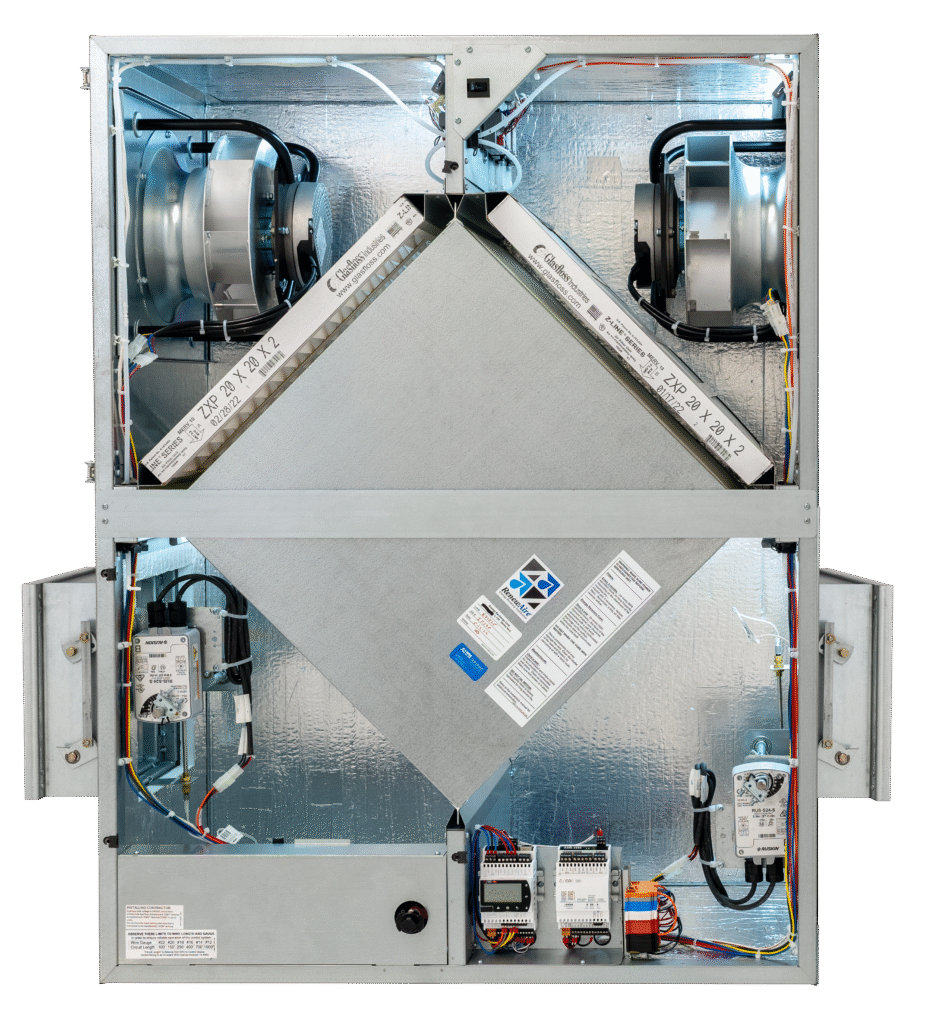
Core Components of an ERV
Motors
RenewAire ERVs feature a variety of motors like direct drive, electronically commutated (EC) motors and variable frequency drive (VFD) motors. For specific offerings, please refer to the unit submittal.
MERV Filters
RenewAire ERVs come with MERV 8 or MERV 10 filters with many models offering MERV 13 filters as accessory. MERV ratings measure how well a filter traps particles from the air. A higher MERV rating means the filter is better at trapping particles.
G5 Core
All RenewAire ERVs have AHRI 1060 certified G5 cores. These static-plate, enthalpy cores are made of an engineered “resin” material that simultaneously transfers heat and humidity from one airstream to the other.
E-Box
All commercial RenewAire ERVs come equipped with e-boxes. The high-voltage supply wiring and low-voltage control wiring is all terminated here. If optional integrated programmable controls are installed, an additional 24VAC transformer is installed here to power both the controller and its dedicated sensors.
Integrated Programmable Controls (IPC)
Many commercial RenewAire ERVs can come installed with enhanced or premium controls.
