
Springing Into Action: A Seasonal Maintenance Guide for RenewAire ERVs
With the recent transition of “springing forward” and the Spring Equinox approaching on March 20th, now is the time to focus on seasonal facility readiness. This shift in the calendar serves as a critical reminder to optimize energy recovery ventilators (ERVs) for the upcoming change in outdoor conditions. Furthermore, since the arrival of Spring often brings with it higher pollen counts and fluctuating humidity levels, implementing a proactive seasonal maintenance routine is paramount. This practice ensures that indoor air remains fresh and systems operate at peak energy efficiency.
Typically, HVAC seasonal maintenance starts and stops with filtration. However, while filtration is a critical component to healthy and safe indoor air quality (IAQ), it’s only part of the story.
The Role of MERV Filtration in IAQ
Before delving into the full maintenance process, we must address why filtration matters. MERV (Minimum Efficiency Reporting Value) ratings determine how effectively a ventilation system removes airborne particles—such as dust, pollen, and smoke. Consequently, a higher MERV rating results in cleaner indoor air and better equipment protection.
For instance, higher ratings (1–16 for residential) mean finer filtration. Therefore, selecting a high-rated filter traps more pollutants while simultaneously protecting sensitive HVAC components from clogging.
Specifically, RenewAire residential units feature MERV 8 filters as standard equipment. However, many of these units offer MERV 13 filtration on the Outdoor Air (OA) airstream as an accessory. Similarly, our commercial ERVs utilize MERV 8 or 10 filters depending on the model. In addition, we provide MERV 13 filters as an accessory for these larger systems to further enhance air hygiene.
Four Essential Steps for a “Spring-Ready” ERV
Adhering to these four steps will ensure optimal performance throughout the season:
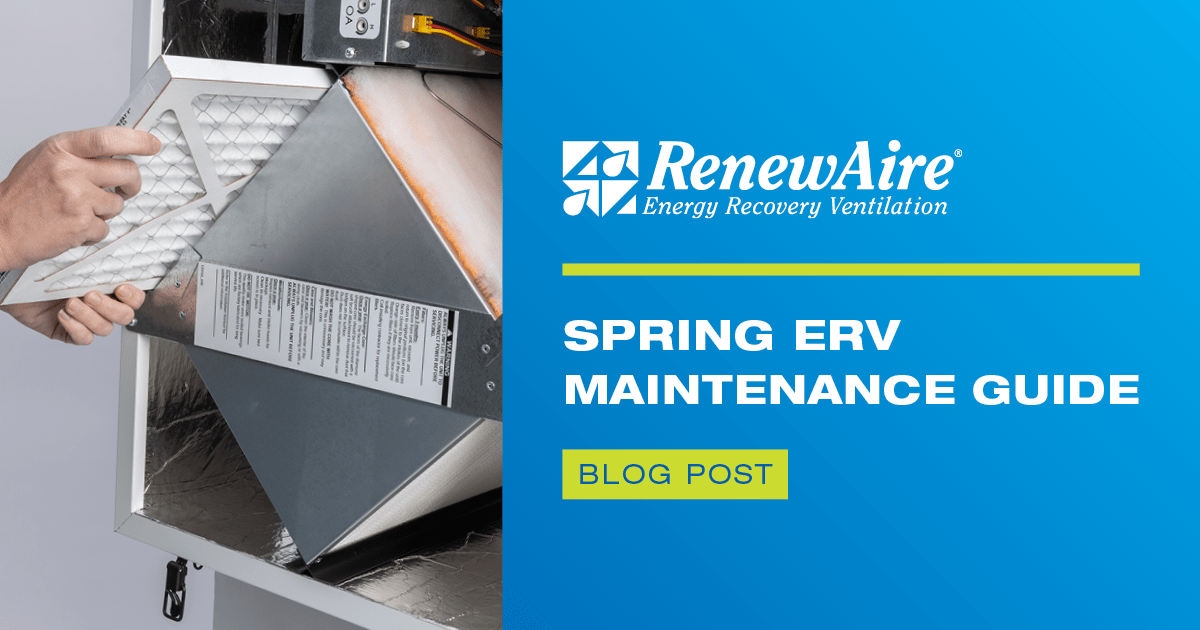
1. Change the Pre-Filters
The 1-inch pre-filters act as the primary defense against outdoor pollutants. Over the winter months, these filters typically accumulate a significant volume of debris.
The Action: Always change pre-filters at regular, recommended intervals.
The Benefit: Clean filters maintain maximum airflow. Additionally, they prevent springtime irritants from entering the building.
2. Clean the Core
The energy recovery core is the heart of a RenewAire unit. While these static-plate cores are engineered for long-term durability, they require a quick seasonal inspection.
Procedure: Open the unit and utilize a vacuum with a soft-bristled brush attachment to gently remove accumulated dust from the core faces.
Technical Note: Never use water or cleaning solutions on the core. Instead, utilize a vacuum to maintain peak energy transfer.
3. Inspect the Motors
ERV motors move fresh air consistently throughout the space. Because of this, a physical inspection can identify potential issues before they impact performance.
The Test: Spin the motors by hand to assess movement.
The Indicator: Listen for any abnormal noise or vibration originating from the motor bearings. Smooth, quiet rotation indicates the motors are in good working order.
4. Check Duct Connections and Insulation
For an ERV to achieve full effectiveness, air must be directed precisely without escaping through unintended gaps.
The Inspection: Verify that all duct connections are tight and properly sealed.
The Extra Step: Confirm that duct insulation remains intact. Because secure seals and robust insulation prevent energy loss, they ensure the efficient delivery of fresh air throughout the facility.
Efficient Maintenance for Long-Term Performance
The design of a RenewAire ERV prioritizes simplicity and reliability. By dedicating time this week to complete this checklist, facility managers and homeowners can ensure a healthy, comfortable, and energy-efficient environment throughout the warmer months.
Maintenance Resources
- Commercial ERVs: Maintenance procedures vary by model. Please refer to your unit’s Installation and Operation Manual (IOM) for specific instructions. Manuals can be found in the Manuals section of our Resource Library, where you can filter by product.
- Residential ERVs: To maintain peak performance and long-term reliability, RenewAire residential ERVs require regular care. We recommend using both the Residential Maintenance Guide for general upkeep and your unit’s Installation and Operation Manual (IOM) for model-specific procedures. As noted above, IOMs are available in the Manuals section of our Resource Library.
Frequently Asked Questions (FAQ)
How often should I check my RenewAire ERV for maintenance?
While our products are incredibly reliable and backed by an industry-leading warranty, we recommend a seasonal check-up every six months. At a minimum, you should inspect your filters every three months and clean the energy recovery core once a year to maintain peak efficiency.
Can I wash the RenewAire energy recovery core with water?
No. RenewAire cores are static-plate enthalpy exchangers. You should only use a vacuum with a soft-bristled brush to remove surface dust. Never use water, solvents, or high-pressure air, as these can damage the core’s material and performance.
What happens if I don't change my ERV filters?
Clogged filters restrict airflow, forcing the motors to work harder and reducing the overall energy recovery efficiency. Furthermore, dirty filters can lead to poor indoor air quality by allowing contaminants like dust or pollen to bypass the filtration system.
How do I lubricate my RenewAire ERV motors?
Short answer? You don’t! Many of our ERVs utilize high-efficiency motors with permanently sealed bearings, which removes the need for manual lubrication. Instead of oiling, simply verify that the impellers rotate freely by hand during your regular maintenance check.