
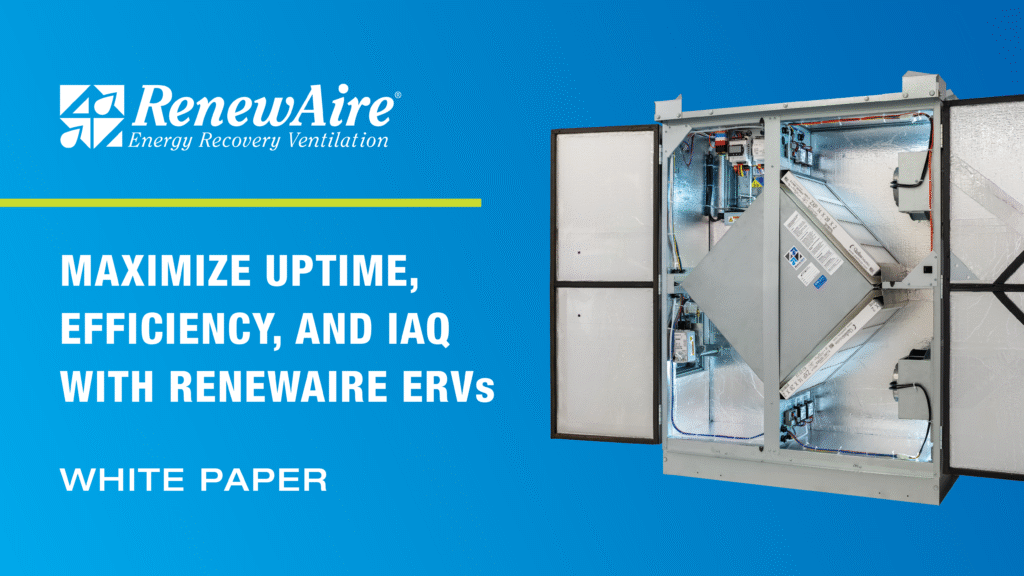
Five reasons why RenewAire ERVs are the best choice for maximizing uptime, efficiency, and indoor air quality (IAQ).
Energy recovery ventilators (ERVs) are the best option for enhancing indoor air quality (IAQ) energy-efficiently, cost-effectively, and sustainably. However, many ERV products exist in the market today and offer a variety of differentiating claims in comparison to other brands. The question then is, how do you know what really is the optimal ERV choice?
In this white paper, I’ll review five key areas specific to ERVs that are receiving increased attention: core washability, antimicrobials, flexibility in product size, airstream cross-contamination, and warranty coverage. I’ll discuss each point and refute some claims made, so as to help shed light on why RenewAire ERVs are the best choice for maximizing uptime, efficiency, and IAQ.
1. Core Washability
There’s talk in the industry about how washing an ERV core improves cleanliness and efficiency. However, this line of thought leaves out one important point: What if the ERV core always maintains utmost cleanliness and doesn’t ever need to be washed? As a result, below are the reasons why core washability is a moot point.
Why Wash the Core When It’s Already Clean
Cleaning an ERV core on a regular basis takes substantial time and money. Why waste these precious resources washing the core when it’s absolutely not necessary with RenewAire ERVs? Through our fifth-generation technology, the cores of RenewAire ERVs are kept consistently clean since submicron particles that enter and pass through the filter maintain their trajectory and exit without soiling the interior. The result is a clean core—all the time.
With RenewAire’s trouble-free ERVs, maintenance is a breeze. All you have to do is check the filters every three months and replace as needed. Surface vacuuming is the minimal maintenance required for the core, and it’s only necessary to do this once a year. There’s never any need to wash the core since it’s always clean.
Not Having to Clean the Core Maximizes Uptime
If washing an ERV core is required, this means that the whole system must be taken out of service to be cleaned. Therefore, not only are you wasting time and money on the cleaning process, but you’re also losing efficiency and more money for every second the ERV is out of commission since it has to be cleaned.
The better choice is RenewAire ERVs, which maximize uptime because they never have to be taken out of service for a cleaning. What’s more, because RenewAire ERVs are incredibly reliable, hardly ever break down, and are built to last for over 20 years, you can be sure they’ll be maintaining their uptime over the life of the system.
A Consistently Clean Core Maintains High Efficiencies
If a core needs to be washed, this means that it’s gradually getting dirtier, leading to a degradation of efficiency. Washing the core simply returns the efficiency level to what it was before the core became soiled. Thus, efficiency isn’t increased, it’s only returned to the original level before being degraded. Combining this with the fact that the ERV is taken out of service for cleaning further compounds efficiency losses.
Alternatively, by using RenewAire ERVs—which don’t lose efficiency due to soiling and never have to be turned off for cleaning—sustained efficiency levels will be constantly maintained. This leads to accurate savings and confident downsizing of HVAC equipment, which is represented by the following equation:
Sustained Efficiency = Accurate Savings + Confident Downsizing
In addition, extra time and cost savings are achieved by not having to clean the core, thus streamlining operations and further optimizing efficiencies through sustainable ventilation.
2. Antimicrobials
Similar to the advent of antibacterial hand soap, the issue of adding antimicrobials to ERVs is being raised. However, like with hand soap, is this an over-exaggerated claim that will only serve to strengthen microbes and usher in an era of superbugs? All signs point to yes, and below are the reasons why incorporating antimicrobials into ERVs is the wrong approach.
Antimicrobial Measures Can Backfire
For the past 150 years, bacteria have been enemy number one as steps have been taken to kill all microbes. However, considerable evidence now exists that shows this approach is failing. Due to these misguided antimicrobial measures, bacteria have become stronger than ever, and a public-health emergency has emerged – the rise of superbugs with antimicrobial resistance (AMR).
In fact, according to the World Health Organization (WHO), AMR has the potential to be even more deadly than cancer and kill as many as 10 million people a year. What’s more, a recent review by the United Kingdom found that AMR can cost the world economy as much as $100 trillion annually.
Antimicrobials are Potentially Unsafe
To kill bacteria, antimicrobials use powerful chemicals that are potentially unsafe for the environment and all life forms. Although manufacturers of antimicrobials assert their products are safe, enough research has been done to find that claim to be worrisome.
One example causing doubt is triclosan, an antibacterial and antimicrobial chemical. In 2013, the Food and Drug Administration (FDA) removed triclosan from its Generally Regarded As Safe (GRAS) list because similar chemicals had potential hormonal effects on animals. In 2016, the FDA banned the tricolan’s use in antibacterial liquid soaps, and now requires that consumer products containing triclosan be labeled.
Triclosan has been proven to have harmful effects on living things. It inhibits the growth, reproduction, and photosynthesis of aquatic plants, and it can cause death, growth inhibition, reduced mobility, and low fertility for aquatic animals. Studies have also shown that triclosan can be toxic to soil microbes, earthworms, and several species of flowering plants.
In addition to triclosan, the FDA warns of the overuse of antibacterial agents in general. The agency contended that some data suggested that long-term exposure of antibacterial ingredients could do more harm than good. The FDA cites such negative consequences as bacterial resistance and hormonal effects as potential health risks. Therefore, antimicrobials should be approached with an abundance of caution.
Using Antimicrobials in HVAC Systems Spreads the Risk
As consensus builds around the potentially harmful effects of antimicrobials, their use is being curtailed in HVAC systems and air filters. This is so because an HVAC system can spread harmful antimicrobials around an indoor space. Supporting this notion is the National Air Duct Cleaners Association (NADCA), which doesn’t recommend the use of chemicals within ductwork unless there’s a specific need.
That said, many HVAC companies still use antimicrobials. In fact, if one is found to potentially have harmful health effects—such as triclosan—it’s replaced with another antimicrobial. The problem is that even though replacements are supposedly safe, it’s likely that as more testing is conducted, health risks will be revealed. Ultimately, it’s better for HVAC companies to avoid using antimicrobials in the first place.
This issue is particularly relevant today as awareness is growing around the harmful effects of deficient indoor air quality (IAQ), which can be exacerbated by the presence of antimicrobials. Caused by a build-up of internally generated contaminants, deficient IAQ can impair people’s health, cognitive function, productivity, and wellbeing. The Environmental Protection Agency (EPA) even lists deficient IAQ as a top-five public health threat.
RenewAire: No Antimicrobials and No Problems for 35 Years
Due to safety concerns around antimicrobials, RenewAire has never used antimicrobials in our products. Since our founding in 1983, we never wanted to incorporate antimicrobials into our systems because of the potential health risks to our customers.
We’re proud to report that for more than 40 years, and hundreds of thousands of units in operation, only a statistically insignificant amount of microbial growth has ever been reported. These few cases were all in situations where the unit was installed either incorrectly or in unusual locations with high-microbial growth, such as a septic tank in one rare case.
3. Flexibility in Product Size
Flexibility is a key differentiator for any HVAC manufacturer, but can product sizing be taken too far, thus adding extra costs to projects? The answer is yes, and flexibility in product size must be balanced with efficiency and product effectiveness. Therefore, it should be considered in conjunction with the points below.
Exaggerated Product Sizing Leads to Diminishing Returns
One of the key differentiators of RenewAire ERVs is the tremendous flexibility they offer. Our ERVs can be applied in every type of home and building, in structures of every size, in every climate, and in every geographic location. RenewAire products can essentially go everywhere to enhance IAQ, optimize energy efficiency, and reduce capital costs.
However, there’s talk in the industry of offering more and more flexibility in product size, but when does it become too much? Yes, it’s possible to take an already efficient product and make it a tad more efficient by changing its size, but the efficiency gains get smaller and smaller, leading to diminishing returns. In the end, the costs expended will be greater than the miniscule amount of efficiency gained.
Capital Equipment Remains the Same
After all the resources spent on product sizing to add a little amount of efficiency, the reality is that the same capital equipment will probably still be in place. This means that the HVAC system can’t be further downsized, thus negating any efficiency gains that might have been achieved. Therefore, the only thing that’s been achieved is less money in your pocket.
4. Airstream Cross-Contamination
ERVs use energy and humidity from the exhaust airstream to condition incoming outdoor air. Therefore, it’s essential that the airstreams be kept separate to avoid cross-contamination of gases, odors, and volatile organic compounds (VOCs). Different ERV manufacturers offer varying levels of cross-contamination protection, and not all are equal.
RenewAire Keeps Airstreams Completely Separate
RenewAire is one of the few companies worldwide to manufacture ERVs that are AHRI EATR-certified for zero exhaust air transfer at normal, balanced operating conditions. This means that airstreams are kept completely separate and all contaminants are expelled. As a result, homes and buildings enjoy the highest levels of IAQ, while also saving energy, with RenewAire ERVs.
5. Core Warranty
In addition to product flexibility, another key attribute is reliability. When you install an ERV, you want it to be trouble-free and built to last over the long-term. That’s why it’s important to pay attention to what type of warranty is offered because that speaks to the quality and reliability of the ERV.
RenewAire Offers One of the Industry’s Best Warranties
We offer one of the industry’s leading 10-year warranties on the static core of our ERVs, and our warranty-claim track record is one of the lowest out of all manufacturers. Our ERVs are also built to last for over 20 years, which provides peace of mind to home and building owners alike.
In Sum
When searching for the best energy recovery ventilation technology, it’s essential to know the facts behind claims by different manufacturers. For over 40 years, RenewAire ERVs have been the optimal choice for maximizing uptime, efficiency, and IAQ in homes and buildings of every type.
Contact us today to find out how RenewAire technologies enhance IAQ energy-efficiently, cost-effectively, and sustainably.