
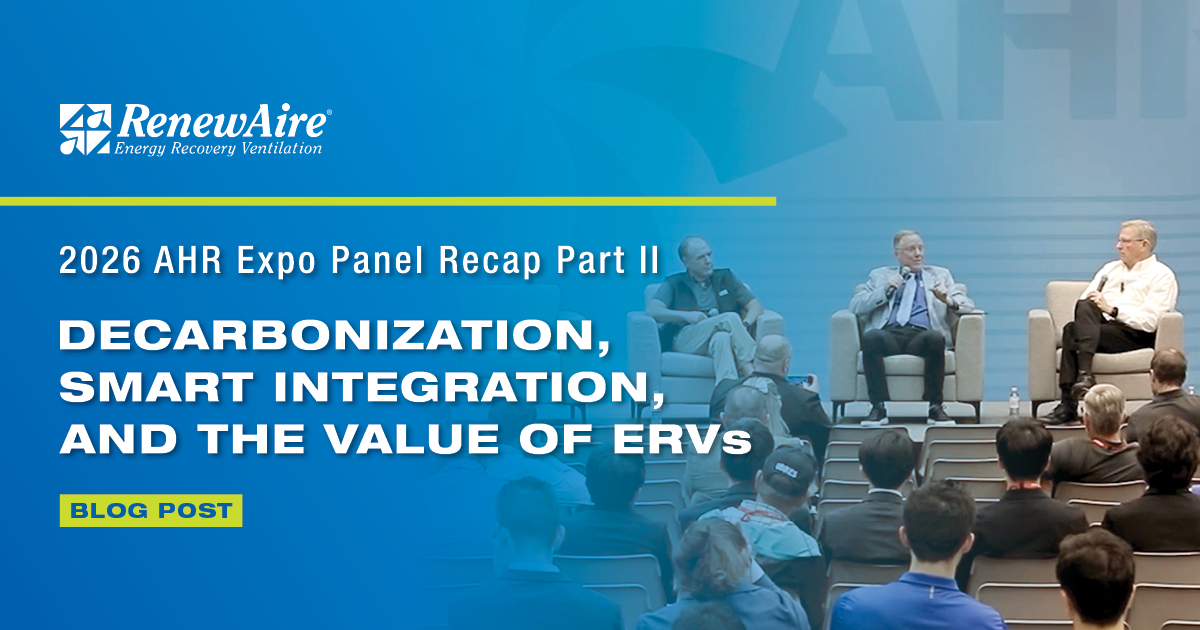
In Part 1 of our 2026 AHR Expo panel recap—featuring RenewAire President Scott Forest, Ken Nelson of Panasonic, and Trevor Schick of AIIR Holdings, moderated by ASHRAE Journal Editor Drew Champlin—we examined awareness gaps, debunked seasonal climate myths, and detailed how energy recovery ventilators (ERVs) drive both capital and operational savings.
In Part 2, our panelists explore the next wave of energy recovery adoption: building science history, decarbonization, Building Management System (BMS) integration, and verified commissioning over prescriptive design.
The Weather-Sealing Paradox: “Build It Tight, Ventilate It Right”
To understand why energy recovery ventilation is central to modern HVAC design, we have to revisit the 1973 oil embargo and the resulting energy crisis. In response, the construction industry implemented aggressive energy conservation tactics—sealing building envelopes tightly and slashing ventilation rates to curb utility costs.
While these aggressive weather-sealing measures eliminated uncontrolled air leakage and reduced energy use, they created a major unintended consequence for indoor air quality (IAQ). As buildings became tighter, pollutants were trapped inside. Without natural drafts to dilute them, volatile organic compounds (VOCs), excess humidity, and bioeffluents quickly accumulated. As air quality declined, occupant health suffered accordingly. The longer individuals spent inside these airtight structures, the worse their symptoms became, leading the World Health Organization to coin the term “Sick Building Syndrome” (SBS).
Today, modern building science relies on a fundamental rule: seal the envelope tightly and ventilate mechanically. Pairing an airtight building envelope with an ERV delivers a continuous, predictable supply of fresh outdoor air while recovering thermal energy from outgoing exhaust air.
Decarbonization & Electrification: Lowering Thermal Load on the Grid
While the energy crisis of the 1970s and ’80s has dissipated, global warming has presented a new challenge. Today, the built environment accounts for over 40% of global CO2 emissions, with HVAC systems driving the vast majority of that load.
Addressing this trend, the panel emphasized that while mechanical ventilation is essential for indoor air quality, conditioning that incoming outdoor air demands massive amounts of energy. As municipalities push to electrify, simply replacing gas furnaces with heat pumps or electric resistance heat can skyrocket equipment costs and grid energy demand if that thermal load remains unmanaged. The panel highlighted that energy recovery is essential to viable electrification through two key mechanisms:
- Reducing Peak Demand: Conditioning outdoor air accounts for a massive portion of HVAC energy loads. By capturing exhaust air energy to pre-temper fresh air, ERVs reduce ventilation energy loads by up to 70%.
- Protecting Grids and Budgets: Lowering thermal loads reduces energy consumption directly at the meter, keeping utility bills manageable for building owners and preventing localized grid overload.
As Scott Forest summarized during the discussion, whether a project focuses on active decarbonization or standard efficiency, “the main thing is that ERVs are gonna help you use less, whatever you’re doing.”
BMS & BAS Integration: Why Integration Isn’t Optimization
Following decarbonization, the panel addressed smart building controls. As facilities adopt automation, integrating ERVs into Building Management Systems (BMS) and Building Automation Systems (BAS) has become a top priority.
While RenewAire units feature native BACnet capability, the panel cautioned that physically connecting an ERV to a control network is only the first step.
As Trevor Schick noted, “Integration’s not optimization.” Connecting components brings zero value if controls aren’t programmed to dynamically manage energy based on real-time data.
True Automated Optimization Requires:
- Shared Sensor Networks: Packaged units leverage shared sensor arrays (, humidity, IAQ, VOCs) to eliminate redundant controls and lower upfront costs.
- Responsive Thermal Control: Tied into a BMS, ERVs communicate with primary chillers and boilers to keep main HVAC equipment running at lower, highly efficient stages.
- Pattern Learning: In multi-family or hospitality spaces, intelligent controls learn usage patterns to dynamically adjust airflow, fan speeds, and sound levels.
Designing Beyond Code: Meeting Standards Like Standard 241
A recurring theme during the forum was moving past minimum code compliance. Relying solely on baseline building codes leaves owners vulnerable to high operating expenses and compromised indoor air quality.
For commercial projects aiming beyond minimum code requirements, the panel pointed to ASHRAE Standard 241 (Control of Infectious Aerosols). Developed in response to lessons learned during the COVID-19 pandemic, the standard establishes guidelines for an “Infection Risk Management Mode” (IRMM) during periods of elevated risk. This framework allows building operators to increase ventilation and equivalent clean airflow (ECA) to meet applicable infection risk management requirements while leveraging energy recovery to help manage the additional heating and cooling demands.
Moving From Prescriptive Design to Verified Commissioning
Designing systems to meet advanced frameworks like ASHRAE Standard 241 is only half the battle; those design intentions must actually translate to jobsite performance. As the panel emphasized, even the most sophisticated HVAC design fails if executed poorly on-site, making the shift from a prescriptive design mindset to mandatory system commissioning essential.
A system may look fully compliant on paper, but compressed ductwork, unbalanced fans, or default factory settings can severely compromise real-world performance. Verified commissioning ensures design airflows are actually delivered at the registers—protecting the engineer’s design intent, validating performance against standards, and guaranteeing long-term ROI for the owner.
Cost-Value Analysis: Reframing First Cost vs. Long-Term ROI
While verified commissioning guarantees that systems perform as intended, panel members noted the main roadblock to ERV adoption: upfront price. Because an ERV has “two fans in a box rather than one,” its initial purchase cost is naturally higher than a basic exhaust fan.
However, the panel pointed out that judging an ERV strictly on its sticker price misses the point. Because of how they are engineered to slash energy loads, ERVs pay for themselves over time. Shifting the focus from upfront capital expenses (CapEx) to long-term operational savings (OpEx) reframes the entire financial picture:
| Evaluation Criteria | Initial Purchase (CapEx) | Long-Term Value (OpEx) |
|---|---|---|
| Equipment Costs | Higher initial price tag (two fans instead of one) | Shrinks the size and cost of primary chillers, furnaces, and heat pumps |
| Ductwork & Layout | Standard exhaust fan setup | Eliminates extra exhaust fan runs and extra wall penetrations |
| Utility Impact | Unconditioned outdoor air spikes energy use | Cuts ventilation heating and cooling energy by up to 70% |
| Overall ROI | Adds to immediate construction costs | Lowers monthly utility bills, boosts property NOI, and raises asset value |
Bridging the Builder-Owner Gap
This financial trade-off highlights a major market disconnect, especially in residential construction: builders pay the upfront equipment costs, but home buyers pay the ongoing utility bills. Because builders don’t see those monthly savings, they often default to lowest-first-cost equipment.
To overcome this gap, the panel urged industry pros to reframe the sales strategy using two key levers:
- Utility Rebates & Regional Incentives: Local energy efficiency rebates can significantly lower initial purchase prices when verified early in project planning.
- Consumer Demand for Health & Wellness: Homebuyers routinely spend thousands on aesthetic upgrades like granite countertops. When contractors position balanced, filtered fresh air as a health and wellness feature, buyers readily value ERVs over standard cosmetic add-ons.
Audience Q&A Highlights: Predictability & Cold-Climate Frost Control
Following the discussion on financial strategies and regional incentives, moderator Drew Champlin opened the floor to the audience for a live Q&A session. The panelists addressed key technical inquiries from attendees:
- Mechanical vs. Natural Ventilation: Natural ventilation is inherently unpredictable—when indoor and outdoor temperatures equalize, natural air movement stops completely. Mechanical ventilation provides continuous, controlled, and predictable airflow year-round.
- Dehumidification vs. Moisture Load Reduction: ERVs are not standalone dehumidifiers, but they significantly reduce incoming outdoor moisture loads before air enters the building. This allows primary cooling equipment and dedicated dehumidifiers to operate much more efficiently.
- Sub-Zero Frost Control: Panelists discussed field testing in extreme cold-weather environments, including Alaska and Wisconsin, with temperatures reaching -40°F. They noted that enthalpic ERV cores offer advantages over sensible-only HRV cores in cold-weather frost management. The panel also highlighted practical installation considerations, such as maintaining at least 10 feet of supply ductwork within the heated building envelope, which can help temper incoming outdoor air and reduce frost risk.
Explore More Insights
As the HVAC industry continues to evolve and building codes change, the AHR Expo panel series provides a valuable platform to educate the engineering and contractor community. To explore more expert discussions, innovations, and upcoming sessions from the broader event lineup, visit the AHR Expo Panel Series.
Watch the Full Discussion:
Access the complete panel video and transcript resources on our AHR Expo Panel Hub Page.
Frequently Asked Questions (FAQs)
What were the key HVAC industry trends discussed at the 2026 AHR Expo?
The 2026 AHR Expo featured numerous panel discussions exploring emerging trends and challenges across the HVAC industry. Topics included building decarbonization, electrification, smart building integration, improved indoor air quality, and the growing importance of energy recovery. Industry experts also emphasized the need to move beyond minimum building code requirements through better system design, verified commissioning, and a greater focus on long-term building performance.
What does "Build It Tight, Ventilate It Right" mean?
“Build It Tight, Ventilate It Right” is a fundamental principle of modern building science. It means constructing buildings with airtight envelopes to minimize uncontrolled air leakage while using mechanical ventilation to provide a continuous supply of fresh outdoor air. Energy recovery ventilators (ERVs) make this approach more energy-efficient by transferring energy and moisture between incoming and outgoing airstreams, helping reduce ventilation-related energy loads.
How do ERVs support building decarbonization and electrification?
ERVs support building decarbonization by reducing the energy required to condition incoming outdoor air. By recovering heat and moisture from exhaust air, RenewAire ERVs, for example, can reduce ventilation-related heating and cooling loads by up to 70%. This lowers overall energy consumption and peak electrical demand, making building electrification more practical while potentially reducing the heating and cooling capacity required from heat pumps and other HVAC equipment.
Want to learn more about the role of energy recovery in building decarbonization? Read our white paper, Decarbonization: The Role of Energy Recovery Ventilation, to explore how ERVs support energy efficiency, electrification, and lower-carbon building strategies.
What is the difference between BMS integration and optimization?
Building Management System (BMS) integration connects HVAC equipment, such as an ERV, to a building’s control network through communication protocols like BACnet. However, integration alone doesn’t guarantee improved performance. True optimization occurs when connected equipment shares information and responds to real-time building conditions, such as occupancy, temperature, humidity, and indoor air quality. Properly programmed controls allow ERVs and other HVAC equipment to coordinate operation, improve efficiency, and maintain occupant comfort.
Why is HVAC commissioning important for ERV performance?
HVAC commissioning verifies that equipment performs as intended after installation. Even a properly designed ventilation system can underperform if ductwork is improperly installed, airflow is unbalanced, or equipment controls are incorrectly configured. Verified commissioning confirms that specified airflow rates are delivered, controls function correctly, and the system operates according to the engineer’s design intent. This helps protect indoor air quality, energy efficiency, and long-term equipment performance
What is ASHRAE Standard 241, and how do ERVs support compliance?
ASHRAE Standard 241, Control of Infectious Aerosols, establishes requirements for reducing exposure to infectious aerosols in buildings. It introduces an Infection Risk Management Mode (IRMM), which allows building operators to increase equivalent clean airflow during periods of elevated infection risk. ERVs support these strategies by providing controlled outdoor air ventilation while recovering energy from exhaust air, helping facilities manage the additional heating and cooling demands associated with increased ventilation. Actual compliance depends on the complete ventilation and air-cleaning strategy, not an ERV alone.
To learn more about ASHRAE Standard 241 and what it means for building ventilation, read our blog post: ASHRAE Standard 241: What You Need to Know.
How do ERVs reduce HVAC costs and improve long-term ROI?
ERVs reduce HVAC costs by preconditioning incoming outdoor air before it reaches primary heating and cooling equipment. This reduces ventilation-related thermal loads and may allow engineers to specify smaller furnaces, boilers, chillers, and heat pumps. Although an ERV adds an upfront equipment cost, reduced HVAC capacity requirements and ongoing utility savings can help offset that investment over the life of the building. For commercial building owners, lower operating expenses can also improve net operating income (NOI).
Want to better understand the financial value of energy recovery? Read our white paper, Net Present Value for RenewAire ERVs, to explore how energy savings, reduced equipment costs, and long-term operational benefits contribute to an ERV’s overall return on investment.