
Energy recovery ventilation isn’t a new concept, but its role in today’s buildings is becoming increasingly important.
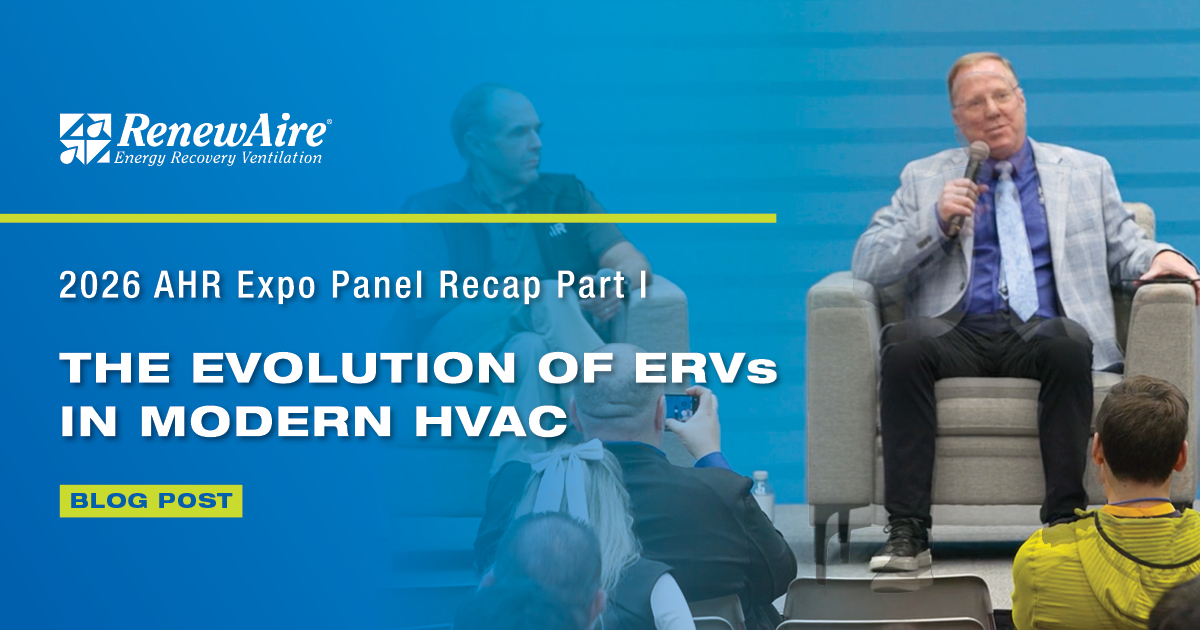
At the 2026 AHR Expo, RenewAire President Scott Forest joined Ken Nelson of Panasonic and Trevor Schick of AIIR Holdings for an expert panel discussion moderated by ASHRAE Journal Editor Drew Champlin. The conversation explored the evolution of ventilation and energy recovery, the current state of ERV adoption, and the immediate opportunities ahead for the HVAC industry.
In Part 1 of our recap, we examine where ERV awareness currently falls short, debunk common climate myths, and break down how energy recovery drives significant financial and equipment savings across all applications.
Where ERV Awareness Still Falls Short
Despite the clear economic and environmental benefits of energy recovery ventilators (ERVs), the panelists agreed that ERV adoption remains inconsistent. Ultimately, a widespread lack of industry awareness and technical understanding remains the single biggest roadblock to integrating energy recovery into modern HVAC design.
RenewAire’s Scott Forest highlighted the stark contrast between the U.S. and international markets like Canada and Europe, where building codes broadly mandate energy recovery ventilation. While most North American building designs reference ASHRAE Standards 62.1, 62.2, and 90.1, these benchmarks are not universally mandated at the federal level. Instead, adoption across the country remains a “patchwork quilt” dictated by a web of varying state and local energy codes.
Beyond regulatory gaps, building occupants and facility owners frequently lack basic familiarity with the technology. Forest illustrated this with a story about visiting a friend’s new home. While giving a tour, his friend pointed to a RenewAire unit mounted on the utility room wall and asked Forest what the product was and how it worked.
Neither the builder nor the installer had taken the time to explain what the ERV was or why it was installed. By failing to communicate the ERV’s purpose in the overall HVAC system, they missed a vital opportunity to educate the homeowner on how essential the unit was to maintaining a healthy, energy-efficient home.
Debunking Climate Myths: ERVs Work in Every Season, Everywhere
Closing this awareness gap requires overcoming a persistent myth in the HVAC industry: that ERVs are merely seasonal products limited to specific climate zones. As the panel pointed out, this misconception actually manifests as two opposing regional myths:
In Southern Climates: The belief that energy recovery ventilation is only beneficial during freezing northern winters.
In Northern Climates (and Canada): The belief that ERVs cannot handle extreme cold, leading designers to default to heat recovery ventilators (HRVs) instead.
The panel dismantled both assumptions, pointing out that choosing an HRV in northern regions leaves massive year-round efficiency on the table. Understanding why comes down to how each technology handles energy transfer:
HRV: Transports sensible heat (temperature) only across its core. While an HRV recovers thermal energy during dry, freezing winters, it offers zero performance benefit during warm, muggy summer months because HRVs do not transfer latent moisture.
ERV: Transports both sensible heat and latent heat (moisture) across a permeable core. This enthalpic transfer enables true four-season energy recovery:
In the Winter: It preheats incoming cold air while retaining vital indoor moisture to keep spaces from becoming uncomfortably dry.
In the Summer: It tempers incoming warm, humid air and strips out excess moisture before it ever reaches the primary cooling coil.
In hot, humid southern states like Florida, air conditioning equipment consumes a major portion of its energy simply removing moisture from incoming outdoor air. Capturing that latent load at the ERV intake drastically reduces peak cooling energy demand during sweltering summers—while still providing seamless performance during the frost events those regions experience each winter. Meanwhile, northern facilities equipped with ERVs gain critical summer pre-cooling and dehumidification that traditional HRVs simply cannot deliver.
Even in milder climate zones, the requirement for balanced ventilation remains essential. As Forest summarized during the discussion, “that doesn’t mean with mild climates you’re not getting energy savings as well.”
The Financial Advantage: Driving Capital and Operating Savings
Understanding moisture movement is central to recognizing the fiscal benfits behind energy recovery ventilation. By recovering total enthalpic energy that would otherwise escape through exhaust streams, ERVs deliver significant, measurable financial advantages:
Lower Operating Costs (OpEx): RenewAire ERVs, for example, are capable of saving up to 70% on ventilation energy costs, often achieving a full payback period in less than two years.
Reduced Upfront Capital Costs (CapEx): Pre-conditioning incoming outdoor air dramatically lowers peak heating and cooling loads. This load reduction allows design engineers and contractors to specify smaller cooling equipment tonnage and smaller furnace capacities. Downsizing primary HVAC equipment offsets the initial purchase price of the ERV, protecting contractor profit margins and lowering upfront construction expenses for developers.
Increased Property Value: Lowering ongoing utility bills increases a commercial facility’s Net Operating Income (NOI), directly boosting long-term asset valuation for building owners.
Bridging the Gap: Tailored Education Across the Industry
The panelists contended that translating these benefits into widespread adoption requires tailored messaging that speaks directly to the specific priorities of each industry stakeholder:
Design Engineers: Technical data demonstrating how energy recovery simplifies code compliance (ASHRAE 62.1 and 62.2) and allows for smaller primary equipment tonnage.
Contractors & Builders: Practical guidance on streamlined installation and how downsizing primary HVAC systems offsets equipment costs to protect bid competitiveness.
Building Owners & Developers: Financial proof illustrating how lower energy bills reduce daily operating costs, boost bottom-line returns, and increase long-term property value.
Homeowners & Occupants: Clear, accessible explanations of how continuous ventilation protects health, controls humidity, and boosts overall indoor air quality (IAQ).
As Panasonic’s Ken Nelson noted during the panel, each stakeholder evaluates building systems through a different lens, so value propositions must directly align with their specific goals.
Coming Up in Part 2
In Part 2 of our recap, we examine the next wave of energy recovery adoption—focusing on handling extreme peak weather events, driving decarbonization and electrification, and integrating ERVs into modern Building Management Systems (BMS).
Watch the Full Discussion:
Access the complete panel video and transcript resources on our AHR Expo Panel Hub Page.
Frequently Asked Questions (FAQs)
What were the key ventilation takeaways from the 2026 AHR Expo panel discussion?
The 2026 AHR Expo panel discussion highlighted that energy recovery ventilators (ERVs) are no longer seasonal or regional niche products, but essential core components of modern HVAC design. Key takeaways included how enthalpic energy transfer addresses latent moisture in all climates, how pre-conditioning ventilation air enables primary equipment downsizing (reducing both CapEx and OpEx), and the critical need for industry-wide education across engineers, contractors, and building owners.
(Note: To view all panel discussions from the show, please visit the official AHR Expo website.)
Why was energy recovery ventilation a central topic at the 2026 AHR Expo?
Energy recovery ventilation took center stage at the 2026 AHR Expo due to strict updates in regional energy codes—such as California Title 24 and the Massachusetts Stretch Code—alongside expanding IAQ standards like ASHRAE Standard 241 (Control of Infectious Aerosols). Panelists emphasized that as modern building envelopes become tighter, ERVs offer the most cost-effective solution for delivering continuous fresh outdoor air without overburdening primary heating and cooling systems or increasing operational costs.
Where can I learn about panel discussions and presentations at the 2027 AHR Expo
While the official 2027 AHR Expo panel series schedule is still being finalized, RenewAire is confirmed to present in the New Product Theater!
Join Timin Musallam, Manager of Product Management at RenewAire, on Tuesday, January 26, 2027, from 11:15 AM – 11:35 AM CST (Theater B, South Hall) at McCormick Place in Chicago. He will present on advanced ERV Frost Control and Factory-Integrated Electric Preheat options for cold-climate resilience. Be sure to add this session to your AHR Show Planner and stop by Booth S7777 to connect with our products and sales team!
What is the primary difference between an ERV and an HRV?
An HRV (heat recovery ventilator) transfers sensible heat (temperature) only across its core, making it suitable for dry, freezing conditions where moisture recovery is not required. An ERV or energy recovery ventilator transfers both sensible heat and latent heat (moisture) across an enthalpy core, managing humidity in both summer and winter for true four-season energy recovery.
To learn more about this topic, check out the following resources from RenewAire: