

Combining Ventilation, Filtration, and Air Disinfection is the Optimal Layering Approach to Stopping the Spread of COVID-19 Indoors
A Layered Approach: Ventilation, Filtration, and Air Disinfection
Experts agree that the primary transmission route of SARS-CoV-2, the coronavirus that causes COVID-19, is through the air. Thus, to counter its spread, mitigation strategies focus on reducing airborne virus aerosols. And similar to combating the cold, a layered approach is the optimal way to enhance indoor air quality (IAQ) and safeguard the health of indoor occupants.
The core of such an approach is increased ventilation, which means bringing in as much outdoor air as possible. Ideally, the ventilation should be balanced so that equal parts of contaminated indoor air are replaced with fresh and filtered outdoor air. Thus, indoor air contaminants—such as viruses—are diluted, thus safeguarding the health of indoor occupants.
With ventilation as the foundation, the layering process begins. The next step is adding filtration to the HVAC system, with a minimum efficiency reporting values (MERV) rating of at least 13. The higher the filtration, the more likely the smallest airborne particles are captured. Finally, air disinfection (also called air cleaning) is added to help neutralize airborne virus particles.
In fact, such a layered approach is gaining traction among leading cognizant authorities, so let’s look at what they say. Below are their recommendations on stopping the spread of COVID-19 (as of the publication of this paper).
Centers for Disease Control and Prevention (CDC)
CDC recommends a layered approach to reduce exposures to SARS-CoV-2, the virus that causes COVID-19. This approach includes using multiple mitigation strategies, including improvements to building ventilation, to reduce the spread of disease and lower the risk of exposure. Regarding ventilation, the CDC states:
- Increase the introduction of outdoor air.
- Ensure ventilation systems operate properly and provide acceptable IAQ for the current occupancy level for each space.
- Rebalance or adjust HVAC systems to increase total airflow to occupied spaces when possible.
- Turn off any demand-controlled ventilation (DCV) controls that reduce air supply based on occupancy or temperature during occupied hours.
Regarding filtration, the CDC states:
- Improve central air filtration:
- Increase air filtration to as high as possible without significantly reducing design airflow. Increased filtration efficiency is especially helpful when enhanced outdoor air delivery options are limited.
- Make sure air filters are properly sized and within their recommended service life.
- Inspect filter housing and racks to ensure appropriate filter fit and minimize air that flows around, instead of through, the filter.
Regarding air disinfection (air cleaning), the CDC states:
- Use portable high-efficiency particulate air (HEPA) fan/filtration systems to enhance air cleaning (especially in high risk areas such as a nurse’s office or areas frequently inhabited by people with a higher likelihood of having COVID-19 and/or an increased risk of getting COVID-19).
- Use ultraviolet germicidal irradiation (UVGI) as a supplemental treatment to inactivate SARS-CoV-2 when options for increasing room ventilation and filtration are limited.
- Please note that using UVGI as a stand-alone system can be problematic, which is discussed in a later section.
American Society of Heating, Refrigerating and Air-Conditioning Engineers (ASHRAE)
ASHRAE states that: “Ventilation and filtration provided by heating, ventilating and air-conditioning systems can reduce the airborne concentration of SARS-CoV-2 and thus the risk of transmission through the air.”
Along these lines, ASHRAE’s Epidemic Task Force compiled core recommendations for reducing airborne infectious aerosol exposure. They are “based on the concept that within limits, ventilation, filtration, and air cleaners can be deployed flexibly to achieve exposure reduction goals subject to constraints that may include comfort, energy use, and costs.” Regarding ventilation, filtration, and air disinfection (air cleaning), the recommendations include:
- Provide and maintain at least the required minimum outdoor airflow rates for ventilation as specified by applicable codes and standards.
- Use combinations of filters and air cleaners that achieve MERV 13 or better levels of performance for air recirculated by HVAC systems.
- Only use air cleaners for which evidence of effectiveness and safety is clear.
- Select control options, including standalone filters and air cleaners, that provide exposure reduction while minimizing associated energy penalties.
Environmental Protection Agency (EPA)
The latest recommendation from the EPA to reduce the risk of indoor airborne transmission of COVID-19 is also a layered approach. This includes:
- Engineering controls are important components of a multilayered approach to reducing the risk of airborne transmission of COVID-19 in an individual building or space. The use of engineering controls such as ventilation and filtration will vary by building, depending in part on the type, age, and capacity of a building’s HVAC systems.
- Increase outside-air ventilation to the maximum practical.
- Increase air filtration by filtering the air that is re-circulated through the building to remove as many aerosol particles as possible. Increasing air filtration may include upgrading HVAC filters to MERV 13 (or the highest MERV rating a building’s ventilation system can accommodate) and placing portable air cleaners in areas that are hard to ventilate with outside air or that have high density or occupancy.
World Health Organization (WHO)
The World Health Organization (WHO) also recommends a layered approach to combat the spread of COVID-19. It states:
- The risk of getting COVID-19 is higher in crowded and inadequately ventilated spaces. These environments are where the virus appears to spread by respiratory droplets or aerosols more efficiently. Understanding and controlling building ventilation can improve the quality of the air we breathe and reduce the risk of indoor health concerns including preventing the virus that causes COVID-19 from spreading indoors.
- A well-designed, maintained, and operated system can reduce the risk of COVID-19 spread in indoor spaces by diluting the concentration of potentially infectious aerosols through ventilation with outside air and filtration and disinfection of recirculated air.
Federation of European Heating, Ventilation and Air Conditioning Associations (REHVA)
In REHVA’s latest pandemic-response document, the focus is on ventilation to counter the spread of COVID-19. It states:
- New evidence on SARS-CoV-2 airborne transmission and general recognition of long-range aerosol-based transmission have developed recently. This has made ventilation measures the most important engineering controls in infection control. While physical distancing is important to avoid close contact, the risk of an airborne transmission and cross-infection over distances more than 1.5 m from an infected person can be reduced with adequate ventilation and effective air distribution solutions.
Minimum Code vs. Increased Ventilation
Without ventilation, contaminants suspended in the air become increasingly concentrated over time. This can cause serious harm to the health and wellbeing of indoor occupants. This scenario is depicted in the image below.
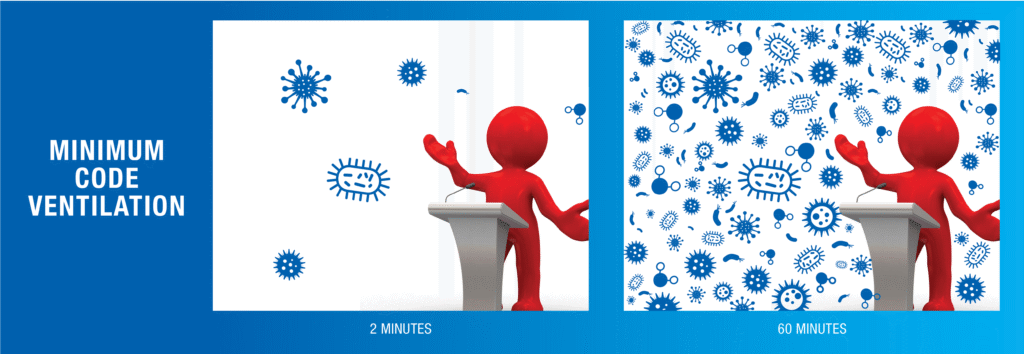
ASHRAE Standards 62.1 (commercial and institutional) and 62.2 (residential) are the main standards for ventilation system design and acceptable IAQ in structures of every type. Both standards specify minimum ventilation rates and other measures to curtail adverse health effects for occupants.
Minimum code is helpful because it ensures that homes and buildings receive at least a certain level of ventilation. However, in the new pandemic normal, it’s important to go above the code limits and bring in as much outdoor air as possible. Thus, with increased ventilation, aerosols and other indoor air contaminants are continuously diluted, reducing the intensity of exposure. This scenario is depicted in the image below.
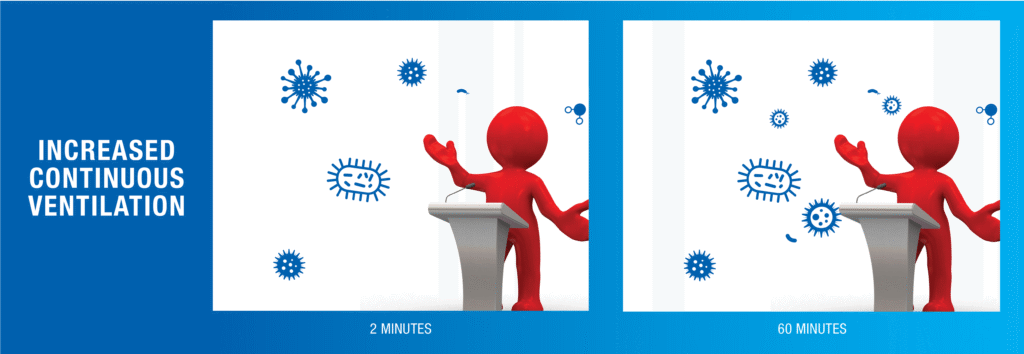
In fact, ASHRAE recommends in its Building Readiness report to increase ventilation as much as possible in certain instances. It states:
- There is potential that building operators could increase their system’s outdoor air ventilation to reduce the recirculation air back to the space. The guidance indicates that this should be done, if it is the selected mitigation strategy for this system, as much as the system and or space conditions will allow.
What’s more, the market now demands higher-performing buildings, and standards are evolving to keep up. One example is the forthcoming ASHRAE 62.1, Section 42 on “Enhanced Indoor Air Quality in Commercial and Institutional Buildings.” It’s still under review, but once approved, it will recommend exceeding minimum requirements for enhancing IAQ.
In addition, certain green-building certifications require extra ventilation over code. For example:
- LEED®: Requires increasing breathing zone outdoor air ventilation rates to all occupied spaces by at least 30% above the minimum rates required by ASHRAE Standard 62.1-2007.
- WELL: The Enhanced Ventilation feature of the WELL certification requires implementation of advanced ventilation strategies that can secure higher air quality levels. Projects exceeding outdoor air supply rates described in ASHRAE 62.1-2010 by 30% or 60% receive one or two points. Further, if CO2 levels are kept at either 900 ppm, 750 ppm, or 600 ppm, it’s worth one, two, or three points.
Watch Out: UVGI Alone Can Be Problematic
As mentioned above, the CDC does recommend using UVGI as a supplemental treatment to inactivate SARS-CoV-2 when options for increasing room ventilation and filtration are limited. Thus, UVGI can play a role, but only in a supplemental manner—not as the chief element.
The ideal scenario is implementing the layers of ventilation, filtration, and air disinfection (such as UVGI). However, studies show that if UVGI systems are used as a stand-alone option, indoor occupants may be at risk.
The adverse effects of sole UVGI use were examined in a study by the Institute for Clean Energy Technology at Mississippi State University. It looked at different ventilation methods to combat COVID-19, and regarding UVGI, the research found:
- UVGI systems have been proven to be effective against various microorganisms many times, but it remains unpredictable how a virus may react over longer periods of time. Overall, the risks and rewards must be analyzed when considering the addition of a UVGI system.
- Risks of using UVGI include:
- UV rays are known to accelerate the rate of decay for different materials, especially polymers such as those used in sealing ductwork and filter seals.
- The risk of mutation is always present with any form of defense against a virus, as viruses and bacteria are known to adapt in order to survive. UV light has also been proven to mutate other microorganisms, such as skin cells in humans, which can lead to cancer.
- A UV wavelength of 185 nm is also known to generate ozone. It has been well established that the toxicity of ozone is a function of its concentration, and that exposure can lead to numerous long-term and short-term effects, causing damage and complications in the lungs and respiratory system, eliciting an immune system activation, and is associated with respiratory-related mortality.
Therefore, utilizing UVGI systems makes sense in certain scenarios, but its implementation must be carefully examined by a professional. This will ensure effectiveness against viruses while safeguarding occupant health.
Evolving Health Standards: LEED®, WELL & Fitwel
Prior to COVID-19, healthier buildings were already of growing concern. However, in the new pandemic landscape, this movement has greatly accelerated. In response, several green-building standards released updated requirements targeting COVID-19. The top ones are LEED®, WELL, and Fitwel:
- LEED®: The LEED® Safety First Pilot Credits were provided in direct response to COVID-19. They focus on the safety of those working in the building as it is re-occupied and consist of several categories: 1) Re-Enter Your Workspace, 2) Cleaning and Disinfecting Your Space, 3) Building Water System Recommissioning, 4) Managing Indoor Air Quality during COVID-19, 5) Pandemic Planning Credit, 6) Social Equity in Pandemic Planning.
- WELL: The WELL Health-Safety Rating for Facility Operations and Management is an evidence-based, third-party verified rating for all new and existing building and facility types focusing on operational policies, maintenance protocols, stakeholder engagement, and emergency plans. The focus of this standard is: 1) Cleaning and Sanitization Procedures, 2) Emergency Preparedness Programs, 3) Health Service Resources, 4) Air and Water Quality Management, 5) Stakeholder Engagement and Communication.
- Fitwel: Created by the CDC and U.S. General Services Administration, Fitwel is a certification system seeking “building health for all.” It introduced the Fitwel Viral Response module, which provides annual, third-party certification of policies and practices informed by the latest public health research on mitigating the spread of contagious diseases. As part of their COVID-19 resources, it covers five areas: 1) Leveraging Buildings to Mitigate Viral Transmission, 2) Building Trust in the Workplace, 3) Addressing Mental Health Within Residential Settings, 4) Optimizing Density for People, 5) Addressing Health Disparities in the Built Environment.
Reality Check: Start With an HVAC Assessment
So, where to start when seeking a healthier building? With new construction, simply prioritize IAQ as a measurable deliverable from the design team and use the latest building codes and guidelines. For existing buildings, it’s a little more complicated.
When seeking to improve an existing building’s indoor health, the place to start is with an HVAC assessment. Contact a building professional to come in and audit the infrastructure. That way it will be clear whether the building is performing to the degree it was designed. It not, then the HVAC expert will outline where improvements can be made.
In many cases, you don’t have what you think you have because, like cars, HVAC systems degrade over time. An example of this is our experience working to enhance IAQ in schools. Cognizant authorities recommend a minimum of six air changes per hour in places of learning. Yet, schools are generally designed for at most three and in most cases the reality is only one-and-a-half. Such a disparity can only be uncovered via an HVAC assessment.
In this case, both the CDC and ASHRAE agree that an HVAC professional should be contacted at the get-go. The CDC states:
- Reoccupying a building during the COVID-19 pandemic should not, in most cases, require new building ventilation systems. However, ventilation system upgrades or improvements can increase the delivery of clean air and dilute potential contaminants. Consult experienced HVAC professionals when considering changes to HVAC systems and equipment.
- It is very important that these overall building systems are evaluated by a qualified design professional to confirm that the modifications for pandemic safety do not create additional issues.
- Care and professional judgement should be taken to understand choices for filtration and air disinfection, pros and cons of each and impact(s) on existing building systems.
- Consider having airflows and system capacities reviewed by design professionals to determine if additional ventilation can be provided without adversely impacting equipment performance and building Indoor Environmental Quality (IEQ).
A Systems Approach To Solving the Problem
To enhance IAQ and protect the health of indoor occupants, a systems approach is the ideal choice. The HVAC mechanical design industry has been addressing this challenge for a long time and is well positioned to provide solutions.
Experts in the HVAC field know what technologies make the most sense for each project. Consequently, they can customize a solution based on the layered approach of ventilation, filtration and air disinfection.
Specifically, the following steps can be taken:
- New construction
- Prioritize IAQ as a measurable deliverable from the design team.
- Use energy recovery ventilators (ERVs) and dedicated outdoor air systems (DOAS) to meet or exceed the applicable energy standard (ASHRAE 90.1).
- Include commissioning of control sequences and sensors to monitor IAQ by room.
- Include MERV 13 filtration as baseline.
- Existing buildings
- Contract an assessment of the current ventilation system. What is the current outdoor airflow in each zone? What is current air change rate?
- Increase ventilation above ASHRAE Standard 62.1 minimum requirements (by 30% or more when possible).
- Increase filtration where possible (MERV 13).
- Upgrade controls and add sensors to gain visibility of air quality.
- Additional considerations
- Schedule control of the HVAC system.
- Preventive maintenance: verify operation damper actuators, replace filters, clean coils, verify airflow.
In Summary
Layering up is a time-tested strategy for dealing with a variety of challenges. Enhancing IAQ and safeguarding indoor occupant health with ventilation, filtration and air disinfection, the layered approach is the best option for countering COVID-19 and creating safer and healthier indoor air.