
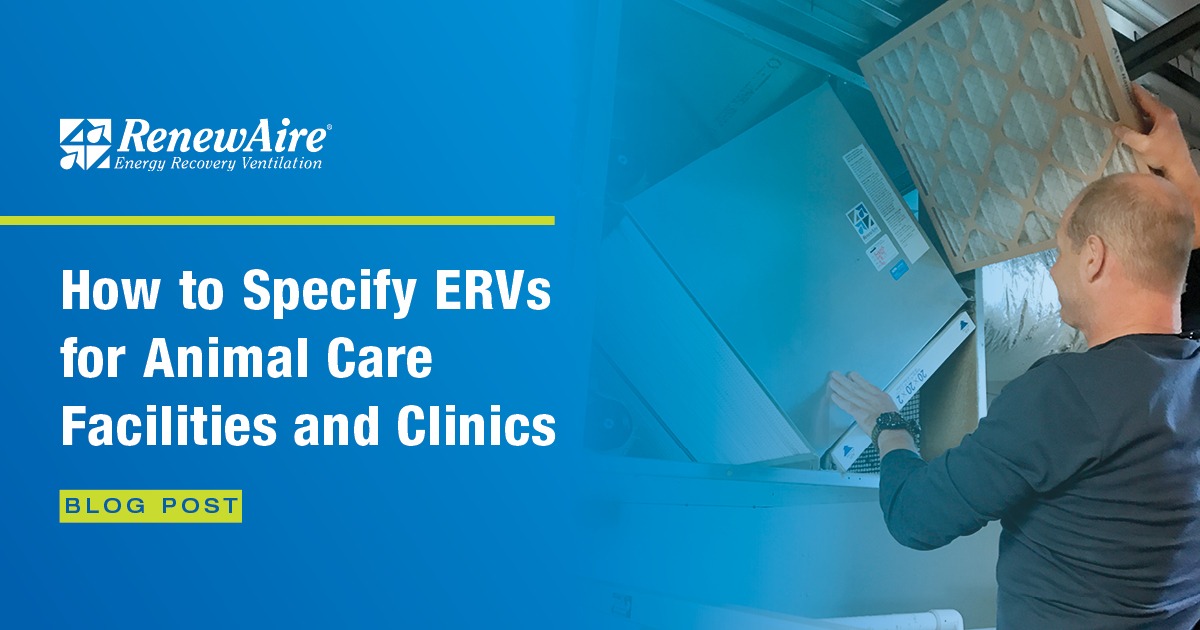
Upgrading a ventilation system is a major decision for any animal care director. These facilities require frequent and costly air changes. Choosing the wrong system can lead to massive energy bills
Energy recovery ventilators (ERVs) solve this problem. They transform air quality from a mounting expense into a long-term asset. These systems reclaim energy that would otherwise go to waste. As a result, they allow for high air-exchange rates without a high “energy penalty.”
Follow these steps to specify a healthy, cost-effective facility.
1. Prioritize Balanced Ventilation and Strategic Zoning
Many animal care designs mistakenly rely on “exhaust-only” strategies. These systems pull air out without providing a fresh supply. This creates a pressure imbalance. Thus, the vacuum can pull contaminated air from a kennel into a “clean” zone like the lobby.
To prevent this, specify a balanced ventilation system. This ensures the exhausted air volume perfectly matches the filtered outdoor air brought in. For animal care, this allows for a “front-to-back” pressure strategy. This standard architectural practice is recommended by the Association of Shelter Veterinarians (ASV):
- The Lobby/Reception: Keep this area at a slightly positive pressure. This ensures air flows away from clients and toward clinical areas.
- The Wards/Isolation: Keep these areas at a negative pressure relative to the rest of the building. Both the ASV and American Veterinary Medical Association (AVMA) advise that air from high-risk areas should never be recirculated. Instead, it must be exhausted directly outside.
2. Mitigate Financial Risks with High-Performance Equipment
Beyond the initial purchase price, evaluate the net present value (NPV) of your equipment. Since renovation costs for these facilities often reach significant levels, the ventilation system must be a high-performing asset.
- Reduce Operational Stress: Inefficient systems cause “sticker shock” on monthly utility bills. However, a high-NPV solution helps to ensure that energy savings offset the cost of the equipment over time.
- Enhance Practice Reputation: A fresh-smelling building signals a high level of care to clients. Eliminating “shelter smell” creates a professional environment that supports your facility’s long-term growth and reputation.
- The “Weather Seal” Factor: High-quality ERVs act as a weather seal for the building. They manage moisture before it reaches the primary HVAC unit to help prevent mold and structural decay in high-humidity areas like grooming blocks.
- Uptime and Reliability: System uptime is non-negotiable in clinical settings. RenewAire units use an energy-exchange core with no moving parts. This design drastically reduces the risk of mechanical failure.
- Proven Payback: While results vary by location and climate, commercial RenewAire ERVs typically see a payback period of less than two years. This efficiency allows you to transform air quality from a mounting expense into a sustainable asset.
3. Neutralize the “Aerosolized Cocktail”
Animal care facilities house a unique mix of indoor air contaminants. These spaces must manage organic matter, chemical cleaners, and biological pathogens simultaneously. Consequently, a standard HVAC system often struggles to maintain a healthy balance.
- The Ammonia Risk: Ammonia is a primary pollutant gas in animal facilities. It can cause significant respiratory irritation. According to the ASV Guidelines, proper ventilation is required to remove these gases. This prevents the buildup of odors and dampness. Without constant air exchange, crated animals may face higher concentrations of these irritants.
Dilute Airborne Pathogens: Pathogens from a single sneeze can remain suspended for hours. Mechanical ventilation is a primary way to physically dilute these airborne dangers. By increasing the delivery of fresh outdoor air, you can help fulfill an effective infection control plan. - The Filtration Factor: While ventilation replaces stale air with fresh air, high-quality filtration provides an essential secondary defense. Using MERV 13 filtration ensures that the incoming outdoor air is stripped of allergens and pollutants before it enters the facility. This combined approach—using ventilation to dilute contaminants and filtration to capture fine particles—is the most effective way to improve indoor air quality.
4. Sizing for 10 Air Changes Per Hour: The HE15 ERV
To meet the clinical requirements of a modern animal care facility, a ventilation system must be capable of moving massive volumes of air 24/7. The Association of Shelter Veterinarians (ASV) and the AVMA generally consider 10 to 20 room air exchanges per hour (ACH) to be the standard for ensuring humane and healthy conditions. The RenewAire HE15 ERV is engineered specifically for these high-load environments.
- High-Capacity Airflow: Delivering 369–1,621 CFM, the HE15 is sized to handle the 10 ACH needed in full-service clinics and kennel blocks.
- Total Stream Isolation: It is critical to ensure that exhaust air and incoming fresh air remain in separate, isolated streams. RenewAire’s static-plate core physically separates the airflows to prevent the recirculation of odors or pathogens while still recovering energy.
- Optimized Operational Costs: The HE15 allows facilities to maintain these high ventilation rates without a proportional spike in energy costs. By pre-conditioning the incoming air, the unit reduces the stress on the primary HVAC system, leading to a more sustainable long-term solution.
Conclusion: A Strategic Investment in Animal Welfare
Specifying a RenewAire energy recovery ventilator is more than a building code requirement; it is a commitment to the health of patients, the comfort of staff, and the long-term viability of the business. By reclaiming up to 70% of the energy from outgoing air, RenewAire technology allows animal care facilities to provide a medical-grade environment that protects every inhabitant while future-proofing the practice for years to come.
Frequently Asked Questions (FAQs)
Why is 10 air changes per hour (ACH) necessary for animal shelters?
According to the American Veterinary Medical Association (AVMA) and the Association of Shelter Veterinarians (ASV), the standard recommendation for animal facilities is between 10 and 20 room air exchanges per hour with fresh air. This rate can vary based on population density, but maintaining this high level of ventilation is essential for managing disease and ensuring humane conditions.
Can an ERV really eliminate "shelter smell?"
Yes, it can help eliminate odors. “Shelter smell” is caused by a buildup of ammonia, dander, and moisture in the air. Unlike a standard HVAC system that recirculates this stale air, a RenewAire ERV physically exhausts 100% of the contaminated air and replaces it with fresh, filtered outdoor air. This continuous “flushing” ensures odors are removed rather than just masked.
What is the difference between an air purifier and an ERV for animal care?
An air purifier uses a filter to trap particles like hair and dust, but it cannot remove gases (like ammonia) or bring in fresh oxygen. An ERV (energy recovery ventilator) is a total ventilation solution. It doesn’t just clean the air; it replaces it. This is essential for managing the high biological loads found in veterinary clinics and shelters
Can an ERV help reduce the spread of kennel cough and other viruses?
While no ventilation system can entirely prevent the spread of disease, increasing indoor air exchange is a primary defense against airborne pathogens. According to the Association of Shelter Veterinarians (ASV), increasing the delivery of fresh outdoor air helps dilute the concentration of viruses—such as canine cough or feline calicivirus—within a facility.
How does a RenewAire ERV assist in infection control
A RenewAire ERV provides a constant supply of fresh, filtered air while simultaneously exhausting stale, germ-laden indoor air. Because the system uses a specialized static-plate core, the exhaust and supply airstreams remain completely separate. This ensures there is no cross-contamination, meaning captured pathogens are moved outside rather than recirculated through the building.
Is it expensive to increase ventilation for better IAQ?
Increasing ventilation to improve indoor air quality could be costly with a traditional HVAC system. In general, traditional systems require heating or cooling the large volumes of incoming “raw” outdoor air. This is where an ERV is particularly helpful. An ERV can help you increase ventilation indoors without incurring a significant increase in energy costs and use. By recovering energy from the exhaust stream, the ERV pre-conditions the incoming air, making the 2024 ASV Guidelines‘s 10–20 air changes per hour (ACH) recommended for clinical settings a sustainable long-term asset.
How will installing an ERV affect my facility's energy bills?
RenewAire ERVs are high-efficiency ventilation systems designed to help reduce ventilation-related energy costs in the long run. While traditional ventilation brings in raw outdoor air that must be heated or cooled, a RenewAire ERV uses a static-plate core to recover up to 70% of the energy from the outgoing air. This pre-conditions the incoming air, which lowers the overall load on your primary HVAC system.
Because of this efficiency, commercial RenewAire ERVs typically see a payback period of less than two years. While actual savings can vary based on local climate and utility rates, these systems generally transform air quality from a mounting operational expense into a sustainable long-term asset.