
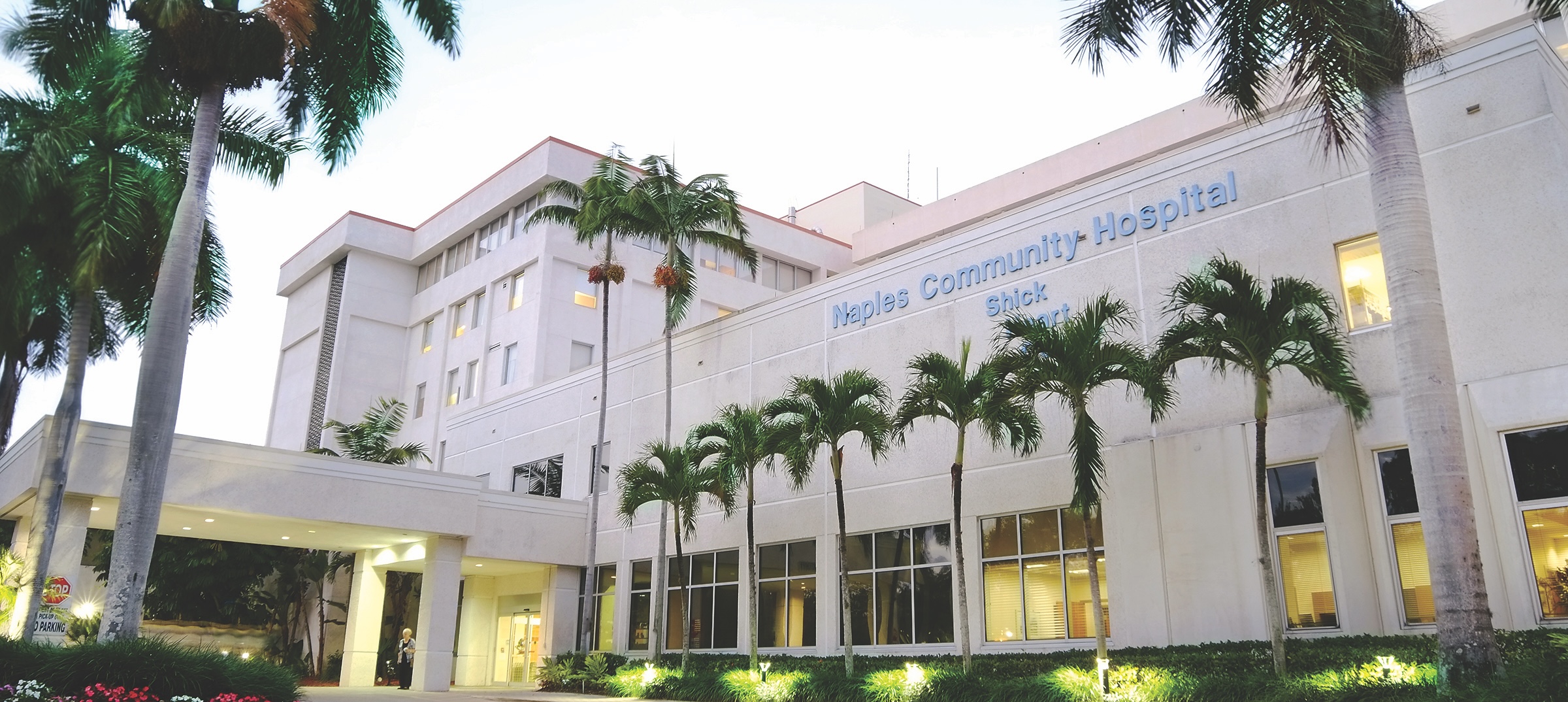
Naples Community Hospital
Engineers and contractors solve refrigeration tonnage constraints in hospital lab HVAC retrofit.
Published: January 30, 2020
At a Glance
Project:
Naples Community Hospital
Location:
Naples, FL
Industry:
Hospital Laboratory
RenewAire ERVs Installed:
Key Outcomes:
- Tight mechanical room could only accommodate custom designed static core array installed in the air handler for energy recovery
- Array consists of 20-inch2 static cores in three vertical stacks of four cores each
- NCH’s maintenance department now prefers static cores for energy recovery, versus the previous enthalpy wheels, which required intensive maintenance
Overview
Poker players would say engineers and contractors were dealt a “tough hand” for the HVAC retrofit of a laboratory at Naples Community Hospital (NCH), Naples, FL.
The Tampa, FL, office of Affiliated Engineers SE Inc. was faced with providing nearly double the refrigeration tonnage, while using the same tight mechanical room footprint as the original 49-year-old, 11,000-CFM, air handler. The refrigeration update was required to handle the increased heat load of cutting-edge electronic lab equipment added over the last decade to make NCH one of Florida’s state-of-the art hospital labs.
An AEI consulting engineer design team led by Nelson Long, P.E., LEED AP, project leader; and Gary Foll, P.E. mechanical engineer, solved the challenge by reducing refrigeration capacity by up to 27-tons, depending on the season, with an array of 12 static-plate enthalpy cores for energy recovery. The refrigeration update also added chilled beams supplied by a secondary chilled water loop, which rejects heat to the 354-bed, 600,000-square-foot hospital’s central plant chilled water loop.
RenewAire Solution
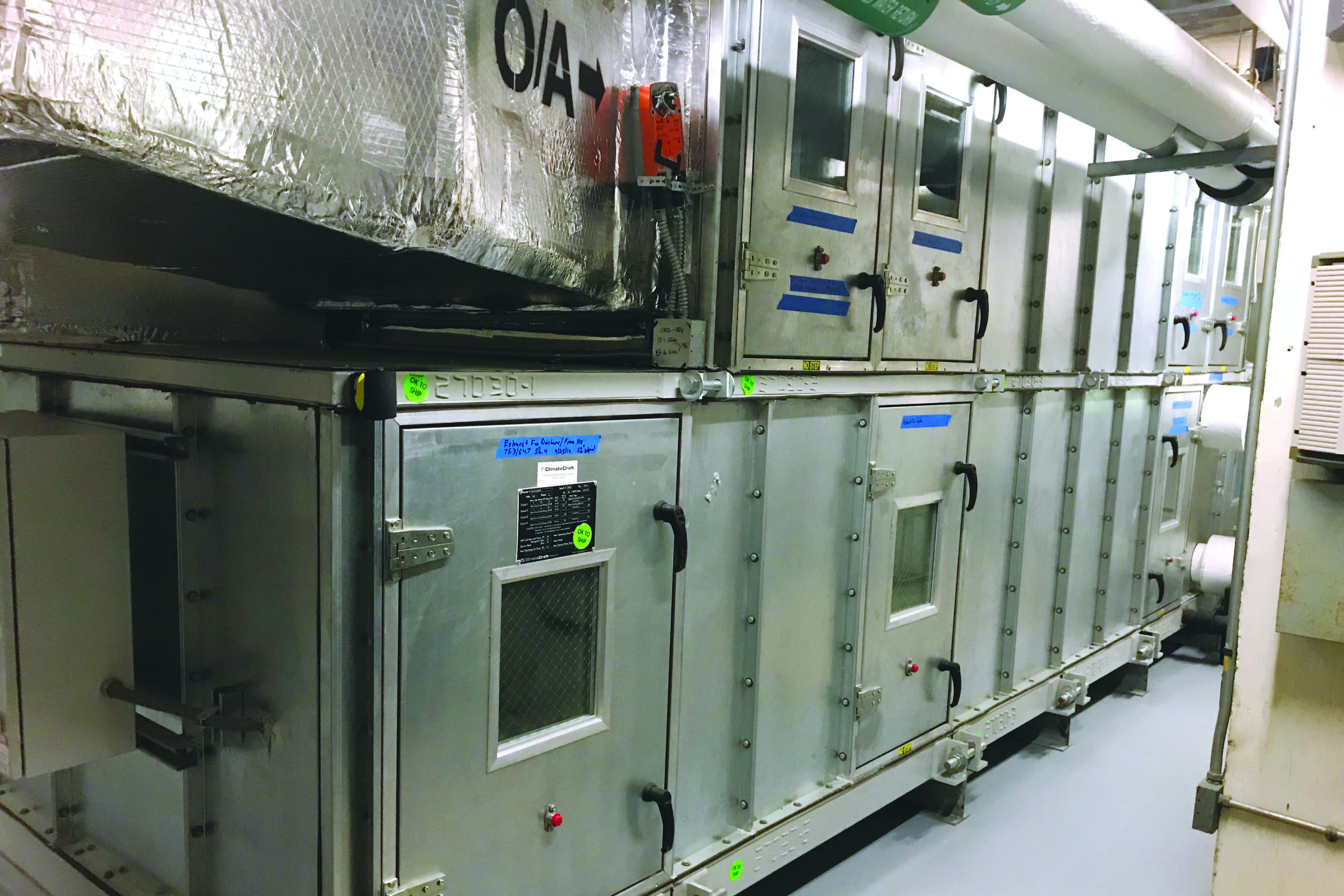
The SA Series Energy Recovery Core Array, which is manufactured by energy recovery ventilation equipment manufacturer RenewAire, Waunakee, WI, preconditions the outdoor air to reduce the latent and sensible loads at the air handler’s cooling coil. It uses exhaust air energy recovery to pretreat outdoor air, which is vital to reducing space dew points and preventing chilled beam condensation. The 20-inch-square static cores were designed in three vertical stacks of four cores installed with accompanying plenum components on a base plate. The array was custom designed to fit the ClimateCraft, Oklahoma City, OK, air handler with a tight fit that minimizes the potential of any lab-compromising cross-contamination. AEI provided the supply and exhaust air CFM; external static, design conditions from lab return and outdoor air, and a desired maximum static pressure of one-inch-w.g.a. The ensuing core array calculation was a collaborative effort that also included manufacturer representative, Keenan Sanz, system sales engineer, Tampa Bay Trane.
Ventilation Challenges
“Cores seem to perform equally to enthalpy wheels and they’re more reliable and require less maintenance, because there aren’t any moving parts.” – Lee Wehr, NCH Director of Facilities
The original air handler had a first generation heat wheel (sensible heat only) that had become irreparable over the years and left the unit inefficient as a 100-percent outdoor unit with no heat recovery. Combined with aged leaking ductwork, the air handler couldn’t reach lab area set point temperatures during extreme summertime Florida weather. Even four supplemental 3-ton split systems couldn’t offset the previous heat load generated by the lab equipment. Furthermore, an additional heat load was anticipated from new Siemens Aptio automated electronic lab equipment NCH brought online to expedite sample analysis and other cutting edge lab functions.
The core array enabled AEI to gain more enthalpy capacity when compared to a wheel. “A wheel with the same capacity of the core array would not have fit the mechanical room constraints,” said Long.
“Cores seem to perform equally to enthalpy wheels and they’re more reliable and require less maintenance, because there aren’t any moving parts,” said Lee Wehr, NCH’s director of facilities, who now prefers cores versus the hospital’s several past maintenance-intensive enthalpy wheels.
The Results
Besides reducing refrigeration tonnage requirements via energy recovery, AEI’s other design innovation includes active chilled beams delivering 109,000-BTUs or 10 tons of cooling. AEI designed a secondary chilled water loop to deliver 59°F water to the ten 9 x 2-foot chilled beams manufactured by Titus, Plano, Texas. The elevated secondary supply water temperature ensures condensation won’t form on the lab’s chilled beams. The chilled beam return water circulates through the secondary loop’s heat exchanger and pump both manufactured by Bell & Gossett, Morton Grove, IL. The secondary loop rejects the heat from the chilled beam return water via a plate and frame heat exchanger connected to the chilled water system from the hospital’s onsite chiller plant. The air handler, with enthalpy assistance from the static cores, delivers 240-CFM to each beam to maintain a lab temperature of 70°F and 50-percent relative humidity. The secondary loop and components are scalable to accommodate future chilled beam cooling upgrades for the 8,000-square-foot periphery that houses the blood bank, histology, microbiology and other areas.
The lab far exceeds minimum requirements of ASHRAE 62.1, 90.1 and 170 standards. For example, the latter’s six air changes/hr. was surpassed with nine total air changes/hr. “The primary air from the new air handling unit gave us more than enough airflow to meet the code air change requirements,” said Long. “We used the active chilled beams to provide additional capacity, not to reduce airflow.”
The air handler was knocked-down into dozens of sections to fit the freight elevator transport and fit through the cramped third-floor mechanical room’s six-foot-wide doorway. It was assembled and installed by project mechanical contractor, United Mechanical Inc., Fort Myers, FL.
“The primary air from the new air handling unit gave us more than enough airflow to meet the code air change requirements. We used the active chilled beams to provide additional capacity, not to reduce airflow.” – Nelson Long, P.E., Affiliated Engineers Inc.
Further complicating the retrofit was keeping the lab operating during construction by using temporary air conditioning and exhaust ducts.
Other added options were ultraviolet irradiation germicidal (UVGI) lamps manufactured by UV Resources, to prevent mold on the cold coils and interior air handler cabinet. MERV 14 filters complement the core array’s MERV 8 filters. Since the mechanical room was originally used as an outdoor air plenum, the AEI team also replaced the original intake screen with a Miami-Dade NOA hurricane-rated louver and designed an outdoor air plenum/duct system that supplies the new air handler.
The project is very successful according to Wehr, and AEI is now scheduled to design a lab HVAC replacement at NCH’s North campus.
Recent Case Studies

[loop_index]
Municipal: Prairie du Sac Town Hall
[loop_index]
Public Safety: Wasilla Police Station