

ERVs are much less susceptible to frost than HRVs and are therefore considered to be the optimal choice for ventilation in extreme climate conditions.
ERV & HRV Frost Thresholds and Control Methods
As structures become more airtight, simply relying on outdoor air finding a way inside for ventilation won’t cut it anymore. Mechanical ventilation is recommended for optimal indoor air quality (IAQ), and under that umbrella, balanced ventilation is the best choice. This can be achieved via an energy recovery ventilator (ERV) or a heat recovery ventilator (HRV).
The COVID-19 pandemic has served as a catalyst for increased ventilation in structures of every type. Replacing stale indoor air with fresh and filtered outdoor significantly minimizes airborne viruses and helps to stop the spread of diseases. Going forward, ventilation rates will only continue to increase to safeguard occupant health–even after the pandemic is behind us. Increased ventilation is here to stay.
As a result, healthier buildings are no longer a lofty goal but instead a necessity to improve occupant wellbeing, with greater ventilation as the foundation. Consequently, there are new building standards, such as the WELL Health-Safety Rating, to classify certain structures as optimal for occupant health.
What’s the difference between an HRV and an ERV? It’s pretty simple. An HRV only recovers heat, whereas an ERV recovers both heat and humidity. This means that an ERV recovers total energy consisting of both heat (sensible energy) and humidity (latent energy). Although the difference between HRVs and ERVs is straightforward, it has a major impact on performance in colder climates. This is due to the issue of frost, which they each handle uniquely. Let’s take a look.
HRVs and Frost
HRVs Need Frost Control
With an HRV, if the outgoing air has enough humidity and the incoming air is cold enough, frost will form in the core. Further, HRVs have a drain pan and condensate line to remove excess liquid, and both of these are susceptible to icing. In general, HRV cores will ice up when outdoor temperatures drop to the low 20s (°F). When frost does occur, this restricts airflow and impairs the ventilation process
There are several frost-prevention and defrosting strategies for air-to-air heat recovery systems that HRVs can employ:
| Frost-Prevention Strategies | |
|---|---|
|
Preheat Coil to Heat Up Outside Air |
Preheat frost control is a preventive strategy that can be used with any air-to-air heat recovery device. The objective is to prevent frost from occurring within the heat exchanger, while maintaining 100% or continuous ventilation. Heat recovery is reduced, because the difference in temperature between the preheated outside air and the return air has decreased. Heating coils (electric, steam or hot water) are duct-mounted or integrated into the unit in the outdoor airstream so that the entering outdoor air temperature is preconditioned to a temperature above the frost threshold. While preheat typically has higher upfront costs, it can result in significant operating savings in climates where frost control is required for a long period of time. |
|
Face and Bypass Damper |
Face and bypass frost control is a preventive strategy that can be used for flat plates, heat pipes and rotary wheel exchangers. As the outdoor air becomes colder, face and bypass dampers upstream of the heat exchanger modulate to reduce the amount of outdoor air flowing through the heat exchanger. This reduces the amount of heat recovered and keeps the exhaust temperature above the frost threshold. With this strategy, there’s no interrupted ventilation and no depressurization of the building, eliminating the potential for combustion appliance backdraft into the occupied space. The lower leaving supply air temperature would potentially require post-conditioning, or some type of terminal reheat within the space to ensure that occupants remain comfortable under extreme conditions. |
| The heat exchanger can be controlled to ensure that frost does not form in the return air by reducing the effectiveness and, as a result, suppressing the frost threshold. For example, wheel rotational speed can be reduced, runaround pumps can be slowed, heat pipes can be equipped with control valves or tilted. Since the heat exchanger is recovering less heat, more heating is required in the process downstream. | |
| Defrosting Strategies | |
|---|---|
|
Exhaust Defrosting: |
Exhaust-only defrost is one of the most cost-effective and simple strategies to implement. It periodically defrosts ice forming on the heat exchanger by shutting down the supply fan to remove the source of cold air, while using the warm exhaust air to heat up the exchanger. When the unit goes into a defrost cycle, the exhaust fan continues to operate, the supply fan is deenergized and the outdoor air damper closes. This method is most commonly used with flat plate or heat pipe heat exchangers and is ideal for source-control applications where continuous exhaust is required. One drawback of this method is that ventilation is interrupted when the supply fan shuts down during the defrost cycle, which may not be acceptable as the equipment may not meet IAQ requirements as defined by ASHRAE Standard 62.1. This also creates negative indoor pressure, resulting in infiltration. |
|
Recirculation Defrost |
Recirculation defrost is also cost-effective and simple, commonly used in light commercial stand-alone air-to-air heat recovery systems that aren’t used as a primary ventilation system. Ice formation on the heat exchanger is periodically defrosted by shutting down the exhaust fan, by closing the outdoor and exhaust air dampers and by opening a recirculation air damper to remove the source of cold air. When the unit goes into a defrost cycle, the supply fan remains on to recirculate building exhaust air back into the occupied space. The exhaust air goes through the heat exchanger and provides defrosting in the absence of cold outdoor air. A drawback of this method is that ventilation is interrupted when the exhaust fan shuts down during the defrost cycle. This may not be acceptable in all applications and may not meet IAQ requirements as set out in ASHRAE Standard 62.1. It may however be acceptable in more moderate climates where freezing conditions occur only during unoccupied hours for a few hours per year. |
ERVs and Frost
ERVs Don’t Need Frost Control 99% of the Time
ERVs are much less susceptible to frost than HRVs for several reasons. The first is the fact that ERV cores transfer humidity in a gaseous state and avoid liquid condensate, thus eliminating the need for drain pans and condensate lines. Therefore, the areas in HRVs most susceptible to icing aren’t even present in ERVs.
Along those lines, because ERVs also recover humidity via an enthalpy core, frost formation is curbed. This is due to ERVs’ ability to transfer moisture between the two airstreams. Subsequently, this process prevents frost because any liquid in the core is in the form of bound water, which is more difficult to freeze. If any frost does form in the case of extremely high indoor humidity and very low outdoor temperatures, it thaws out quickly.
For example, a typical residential ERV will have up to an 18°F lower frost threshold than a similar HRV at 70°F and 30% relative humidity (RH) indoor conditions. In general, ERV cores may not develop icing problems until outdoor temperatures drop to the low teens (°F).
In extreme climate conditions, ERVs are considered to be the optimal choice when compared to HRVs. This is because when HRVs are in situations with a large temperature gradient between airstreams, and at least one of those airstreams is even slightly humidified, condensation is sure to occur in the unit. The result can be mold and impaired IAQ.
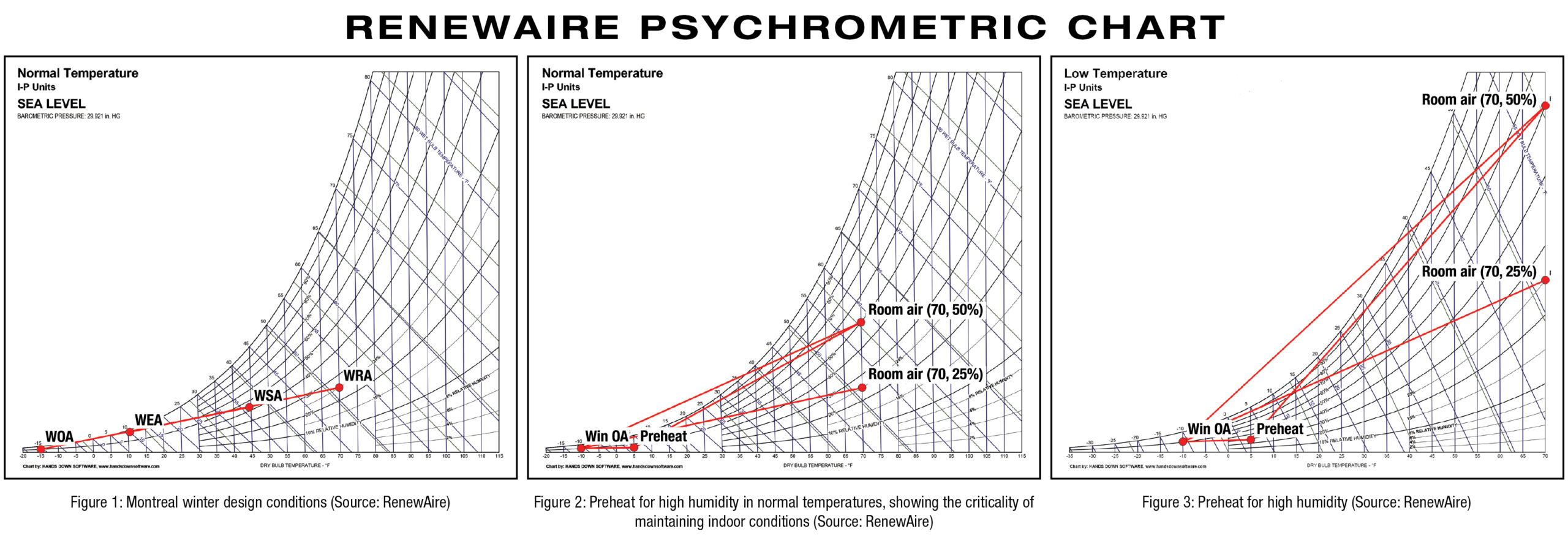
This isn’t the case with ERVs. Here are several psychometric charts demonstrating the high efficacy of ERVs:
Reality Check: Wintertime Indoor Conditions
What are indoor conditions in the wintertime really like? Is it always 70°F with 40-60% relative humidity? Although this is considered to be “ideal,” this is not normally the case in winter. That’s due to the binary relationship of outdoor temperature and indoor relative humidity. The colder it is outside, the lower the indoor relative humidity will be, naturally.
In fact, in extremely cold climates, it’s recommended that indoor relative humidity levels be kept purposely lower. This is because if humidity is too high, moisture will likely collect in wall and attic cavities and cause structural damage. Also, mold can form, which has the potential to make people sick. Below is a list compiled by the Minnesota Department of Public Service on ideal wintertime indoor relative humidity levels. It’s based on double-glazed windows and an indoor temperature of 70°F. Notice that the lower the outdoor temperature, the lower the indoor relative humidity should be:
|
Outside Temperature |
Recommended Indoor Relative Humidity |
|
20–40°F |
Not more than 40% |
|
10–20°F |
Not more than 35% |
|
0–10°F |
Not more than 30% |
|
-10–0°F |
Not more than 25% |
|
-20–-10°F |
Not more than 20% |
|
Lower than -20°F |
Not more than 15% |
Figure 4: Ideal wintertime indoor relative humidity levels based on double-glazed windows and an indoor temperature of 70°F. (Source: Minnesota Department of Public Service)
In addition, the binary relationship between outdoor air temperature and indoor relative humidity supports ERVs’ ability to combat frost. This is because when the temperature outside plunges, indoor humidity levels also drop significantly. For this reason, the colder it gets–and with corresponding drops of indoor relative humidity–the harder it is for the ERV core to freeze.
The Rare Chance an ERV Can Freeze
So, when can an ERV freeze? It’s very rare–indeed, during the 2020–2021 severe cold snap in North America, RenewAire received no calls about freezing cores. Moreover, a RenewAire ERV was used to help secure a 40,000-year-old ice record from the South Pole. In that case, the ERV operated flawlessly in -40°F conditions.
Also, a study was done in Alaska to determine if ERVs could perform in cold climates without frosting failure. It found that, “there were no observed instances of mechanical failure due to excessive frost in the systems, which may indicate that all of the units have adequate defrost strategies for use in cold climates.”
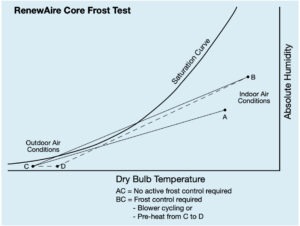
RenewAire sticks to our frost-control policy, which states: “RenewAire’s ERV energy exchange core performs without condensing or frosting under normal operating conditions (defined as outside temperatures above -10°F and inside relative humidity below 40%). Occasionally, more extreme conditions will not affect the usual function, performance or durability of the core. However, to ensure good product performance, avoid crossing the saturation curve on a psychometric chart.” This is demonstrated in figure 5: It’s worth noting that if there is any frost, this is different from the core freezing. Hence, if frost does occur, we recommend using one of the ASHRAE defrosting strategies listed above. These include either utilizing exhaust air or implementing recirculation to melt the frost.
However, on very rare occasions, the freezing of an ERV core can happen. For example, it happened to one of our ERVs in a perfect storm of adverse conditions. The facility was a large cold-climate gym–with a lot of shower stalls–sandwiched between an Olympic-sized pool and a major hospital. Needless to say, there were many humidity sources.
On top of that, the hospital prevented locker-room air from going into the building, exhaust fans were faulty, there was no wall built to protect against humidity and the facility’s door was flimsy. Consequently, indoor relative humidity levels were way above 50%. Combine that with harsh wintertime temperatures, and voila–a frozen ERV core. A technician was called, and the problem was fixed quickly.
Figure 5: RenewAire core frost test via psychrometric chart. This is a depiction of B and C crossing a line. If you want to maintain C, lower indoor conditions from B to A or depict an actual indoor condition or not a design condition. (Source: RenewAire)
HVI and Energy Star Certifications
Before closing, let’s look briefly at the different types of HRV and ERV certifications that exist, focusing on residential applications. The two main organizations are ENERGY STAR and the Home Ventilating Institute (HVI). They both test all aspects of how the systems function, including frost control.
As it relates to cold-climate situations, they state the following:
- To be ENERGY STAR certified, the below attributes are examined:
- Products must be tested and meet sensible heat-recovery efficiency (SRE) requirements at 32°F (0°C) and -13°F (-25°C).
- Products must meet fan efficacy requirements in a test that also meets SRE requirements at 32°F (0°C).
- All net supply airflows in tests used to meet SRE and fan efficacy requirements must be within 10% of each other.
- To be Home Ventilating Institute certified, the below attributes are examined:
- Heating-Season Performance: This is a mandatory test for HVI Certification at 0°C (+32°F) and 75% relative humidity for the outdoor air and at 22°C (71.6°F) and 40% relative humidity for the indoor air. This test represents the typical steady-state energy performance of the HRV/ERV. Performance is more comparable using this Heating Season Performance data due to the absence of frost formation.
- Very Low Temperature Test: This is an optional test for HVI Certification. The Very Low Temperature Test is typically conducted at -25°C (-13°F) and at 22°C (71.6°F) and 40% relative humidity for the indoor air, although the manufacturer may choose to conduct this test at any outdoor temperature below freezing. The test duration is 72 hours. The Net Supply Airflow and all other energy performance values are calculated by using the averages of the last 60 hours of the test.
In Summary
In the COVID-19 era, healthy buildings are of paramount importance, making increased and balanced ventilation a vital component. To achieve this, the best choice is either an HRV or ERV. Both are effective at enhancing IAQ while saving energy, but with total energy recovery, ERVs are superior at combatting frost.
What’s more, ERVs save more energy because of their total energy recovery. They also offer dehumidification of the outdoor air coming inside during summertime conditions. Finally, HVAC systems can be downsized because both sensible and latent loads are decreased. Thus, it’s clear that ERVs are an ideal choice for every type of climate, including the coldest ones in North America.
For more information on the essential role of ventilation in creating healthy buildings, contact RenewAire today to specify an ERV.

Frequently Asked Questions
Do ERVs outperform HRVs in cold climates?
+
While HRVs are often considered the traditional choice for cold weather, static-plate ERVs offer a superior solution in sub-zero conditions. Because humidity transfers as a vapor across the enthalpy core, the core resists freezing, eliminating the need for defrost cycles that interrupt fresh airflow. Furthermore, because no liquid condensate is produced, static-plate ERVs require no drain pans or condensate lines—removing the risk of frozen pipes and enabling flexible installation in any orientation.
RenewAire ERVs leverage this static-plate technology to deliver continuous, balanced ventilation without defrost delays. Beyond winter performance, energy recovery works year-round by pre-cooling and dehumidifying incoming air in the summer, making it a true four-season approach to reducing HVAC energy costs.
Check out some real world examples of RenewAire ERVs in cold climates: